Since the night of April 8th, multiple areas in Hubei have been hit by severe convective weather including heavy rain, thunderstorms, strong winds, and hail. By 10:00 AM on April 9th, cumulative rainfall in Wuhan, Tianmen, Xiantao, and Hanchuan had exceeded 100 millimeters. Public security authorities in Hubei immediately activated emergency response mechanisms, organizing police officers and auxiliary police to work on the front lines of disaster relief, rescue operations, traffic control, and hazard inspections, building a strong line of defense for the safety of people’s lives and property.
Wuhan police manually cleared a sewer drain blocked by debris.
At 0:51 AM on April 9th, heavy rain poured down like a waterfall in the Shipping New Village of Yingcheng City, with lightning tearing through the night sky. On-duty police officers from the Yingcheng City Public Security Bureau’s Urban Police Station received an alert that two residents were trapped in their home, with floodwaters rising rapidly.
A police car sped through the flooded streets to the scene. Upon getting out, the officers saw the alley completely submerged. Murky, knee-deep water was rising towards waist level. The front door of the house where the residents were trapped was being held shut by water pressure, making it impossible to push open from the outside, while anxious cries for help came from inside.
The officers made a quick decision. They forced the door open and waded through the waist-deep, murky water into the dark house to search. They successfully evacuated both trapped residents to a safe area. After confirming the residents were unharmed, the officers carefully advised them to stay with relatives or friends for the time being.
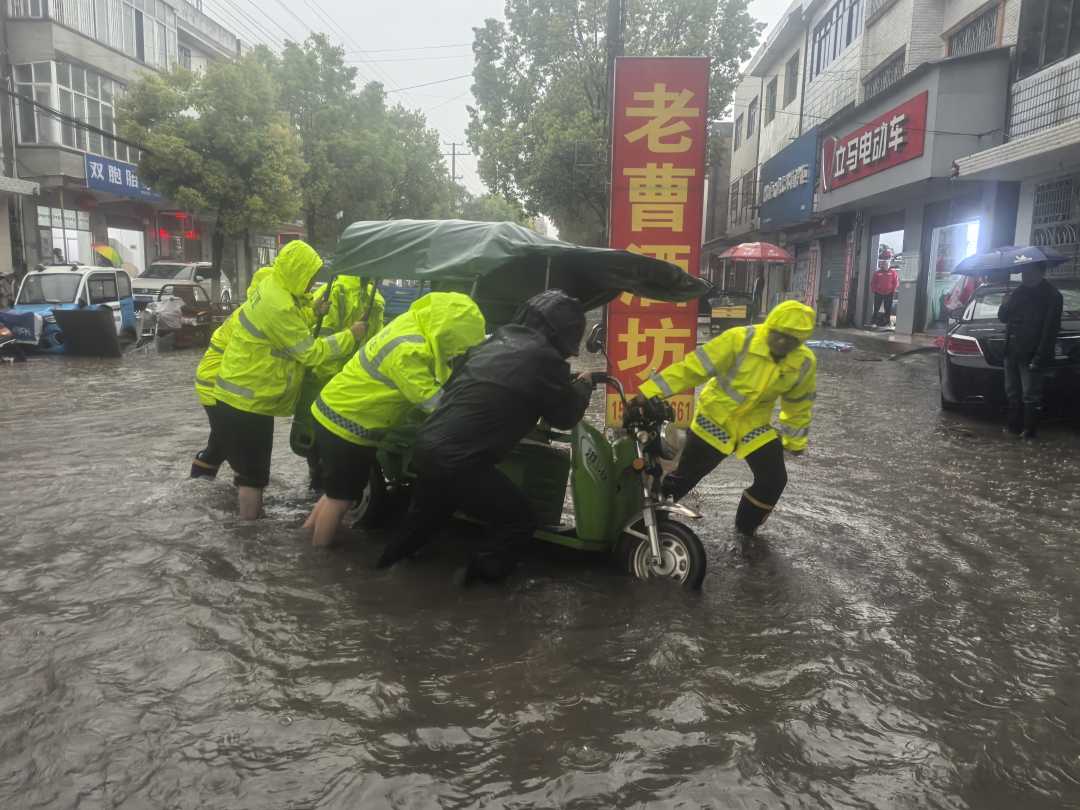
Zhijiang police helped residents move vehicles trapped in deep floodwaters.
With the heavy rain coinciding with the morning rush hour, areas with high concentrations of people such as schools, commercial districts, and hospitals became key protection points. In response, public security authorities across various regions formed emergency response teams to conduct continuous patrols of flooded road sections, traffic congestion points, and hazardous locations. They coordinated with departments such as landscaping, telecommunications, road administration, and water services to form a joint response force. Emergency assistance channels were also opened to minimize public losses.
In Wuhan, local police worked in the rain, focusing on areas around schools, construction sites, and major thoroughfares. On April 9th, at a construction site on Chang’an Road near Gutian 4th Road, a sewer drain entrance was completely blocked by fallen leaves and debris, preventing floodwater from receding. An officer from the Wuhan Public Security Bureau’s Qiaokou District Traffic Police Brigade’s Quick Response Motor Unit rolled up his sleeves and manually cleared the blockage. The water quickly drained, and traffic flow was restored.
In Xiantao, the Xiantao Public Security Bureau implemented tiered management measures—”warning, restriction, closure”—based on floodwater depth. Police officers and auxiliary police became “vehicle pushers,” braving the rain to assist stalled cars. On the morning of April 9th, during patrols, officers discovered trees blown over by strong winds blocking the road. They quickly cleared the obstacles to ensure road safety in their jurisdiction.
In Yichang, local public security authorities used a video inspection system to monitor the urban road network around the clock, paying special attention to over 20 flood-prone sections. They also mobilized 386 road chiefs and 1,114 traffic guides to be fully deployed. Patrol frequency was increased along more than 50 key routes and over 30 congestion-prone areas. Ten law enforcement service stations were activated simultaneously to manage traffic order during peak hours around commercial districts and schools.
Wuhan Dongxihu police located an elderly person who went missing during the stormy night. Tianmen police carried out emergency rescues for people and vehicles trapped by the heavy rain. Police in Huangshi, Qianjiang, and other areas coordinated with relevant departments to clear road flooding and upright fallen guardrails…
By 4:00 PM on April 9th, provincial public security authorities had received 187 rain-related alerts. Police officers and auxiliary police across all regions responded promptly and appropriately. Treating the rainfall as an emergency call, Hubei’s public security authorities will maintain a high level of readiness, standing by 24/7, continuously inspecting hazardous points, and preparing to respond to any sudden dangers at any time.
The rain hasn’t stopped, and they haven’t withdrawn—those shades of “navy blue” and “fluorescent yellow” remain steadfast where