The village mayor of Ogasawara to express views on literature survey for nuclear waste disposal site; challenges of Minamitorishima proposal.
The selection of a final disposal site for high-level radioactive waste is under discussion. On the 13th, Mayor Masaaki Shibuya of Ogasawara Village will present his views at an explanatory meeting for residents, following a request from the national government to conduct a literature survey on Minamitorishima (South Bird Island). Attention is focused on whether his explanation will extend to a decision on accepting the literature survey.
The national government proposed conducting the literature survey on Minamitorishima to the village on March 3rd, prior to any formal nomination or resolution by the village assembly. The government and related bodies held two explanatory meetings each on Chichijima on March 14th and on Hahajima on March 21st. A total of 308 people participated, representing about 10% of the village population. Residents raised questions and concerns regarding the survey and potential final disposal, including inquiries about countermeasures. Questions were also reportedly raised about the relationship with the development of rare earth elements on the seabed around Minamitorishima.
The meeting scheduled for April 13th is an “Explanatory Meeting from the Mayor.” The village announced the meeting on the 1st, explaining on its website and public relations magazine for residents: “Based on the opinions received from residents and various voices from outside the village, we have decided to provide a venue for the mayor to directly convey his views to the residents.”
The meeting will be held on Hahajima from noon and on Chichijima from 7 p.m. It is planned to be closed to the press.
A Disposal Site on Minamitorishima? National Government’s Responses to Residents’ Concerns
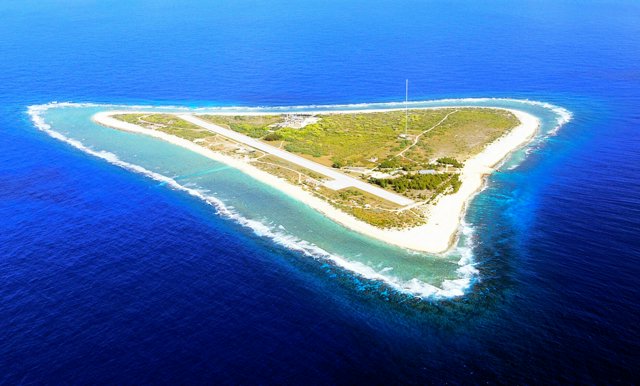
Minamitorishima is located about 1,950 km from central Tokyo and approximately 1,200 km from Chichijima in the Ogasawara Islands. Situated far beyond the seismically active mainland on the Pacific Plate, it has long been noted by some as a location free from concerns about earthquakes or volcanic activity. The entire island is state-owned land with no general residents.
However, the island’s area is 1.5 square kilometers…
Minamitorishima
Minamitorishima, also known as Marcus Island, is a remote, isolated Japanese island in the northwestern Pacific Ocean. Historically uninhabited, it was formally claimed by Japan in the late 19th century and has since been administered as part of Tokyo Metropolis. Today, it serves primarily as a meteorological and strategic outpost, hosting a weather station and a small Japan Self-Defense Forces facility.
South Bird Island
South Bird Island is a small, uninhabited island located off the coast of Texas in the United States, part of the larger Laguna Madre ecosystem. It is primarily known as a critical nesting sanctuary and protected wildlife refuge for a variety of seabirds, most notably the largest breeding colony of brown pelicans in Texas. The island’s history is one of environmental preservation, having been designated to protect these bird populations from human disturbance and habitat loss.
Ogasawara Village
Ogasawara Village is a remote island municipality located in the Ogasawara (Bonin) Islands of Japan, approximately 1,000 kilometers south of Tokyo. Historically uninhabited until the 19th century, the islands were settled by a mix of Westerners, Polynesians, and Japanese, and were formally incorporated into Japan in the 1870s. Today, the village is renowned for its unique ecosystem and is a UNESCO World Heritage site, often called the “Galápagos of the Orient.”
Chichijima
Chichijima is the largest and most populated island in the Ogasawara (Bonin) Islands of Japan. It was first settled by a small group of Westerners and Pacific Islanders in the 1830s before coming under Japanese control in the late 19th century. During World War II, it served as a key Japanese military base and was later administered by the United States until its return to Japan in 1968.
Hahajima
Hahajima, meaning “Mother Island,” is the second-largest island in the Ogasawara (Bonin) archipelago of Japan. It was first settled by a small group of Westerners and Pacific Islanders in the 1830s before coming under Japanese control in the 1870s. Today, it is a remote, UNESCO World Heritage site known for its unique subtropical forests and endemic species.
Ogasawara Islands
The Ogasawara Islands, also known as the Bonin Islands, are a remote volcanic archipelago about 1,000 km south of Tokyo. They were first settled in 1830 by a small international group and were later claimed by Japan in the late 19th century. Today, they are a UNESCO World Heritage site renowned for their unique, isolated ecosystems and endemic species.
Tokyo
Tokyo, originally a small fishing village called Edo, rose to prominence after becoming the seat of the Tokugawa shogunate in 1603. It was renamed Tokyo (“Eastern Capital”) when the emperor moved there during the Meiji Restoration in 1868, solidifying its status as Japan’s political and cultural center. Today, it is a vast, modern metropolis known for its cutting-edge technology, historic temples, and dense urban landscape.
Pacific Plate
The Pacific Plate is the largest tectonic plate on Earth, underlying much of the Pacific Ocean. It formed over 190 million years ago from the remnants of the ancient Farallon Plate, and its ongoing movement, particularly along the “Ring of Fire,” is responsible for frequent earthquakes and volcanic activity along its boundaries.