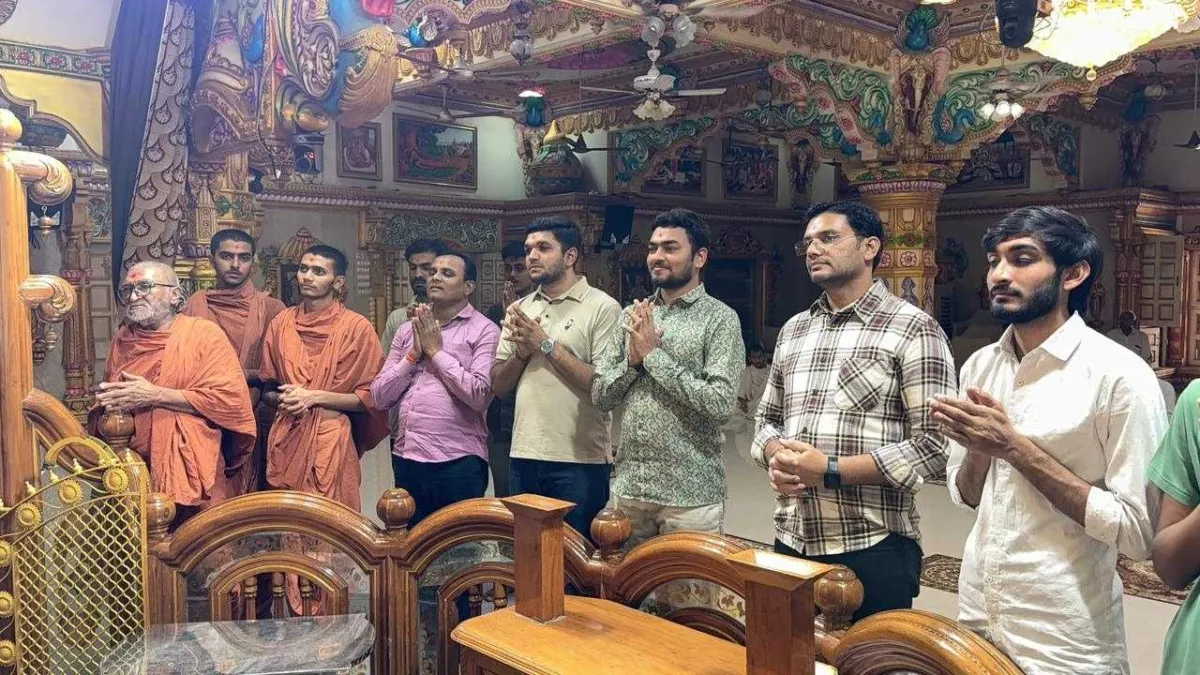
A unique example of reverence and devotion in the service of Lord Shri Swaminarayan was witnessed at the Shri Swaminarayan Gurukul on Ved Road, Surat, on the occasion of the summer season. Here, saints, alumni, devotees, and female worshippers together created an attractive Vaghā (garment) for the Lord using flower buds and petals.
This service activity, which lasted from 8 AM to 3 PM, used fragrant flowers like Dolār, Mogra, Jasmine, Rose, Orchid, and Gerbera to create the Vaghā in colorful designs. This service is based on the Vaishnava tradition’s principle of ‘Jaisi Deh Vaisi Seva’ (service according to the body’s state), where devotees aim to please the Lord by serving Him according to the season.
The saints of the Gurukul explained that just as humans adopt a lifestyle according to their seasonal needs, similarly, the service to God is performed in accordance with the season. In the summer season, special adornment with flowers and sandalwood is done to provide coolness to the Lord.
Under the guidance of Pujari Vivekswarupdasji Swami, the saints and devotees prepared beautiful floral attire for Thakorji. This service saw the active participation of many saints, parishads, youth, and female devotees.
During the four months of summer, there is a tradition in the Swaminarayan sect to adorn the Lord with fragrant flower garlands, armlets, bracelets, crowns, and other ornaments. Additionally, hymns and devotional songs related to floral decoration, composed by saints approximately 200 years ago, are also sung.
On this occasion, hymns and devotional songs were presented, pleasing the Lord and filling the entire campus with an atmosphere of devotion and joy.
Shri Swaminarayan Gurukul
Shri Swaminarayan Gurukul is a prominent educational and spiritual institution rooted in the Swaminarayan tradition of Hinduism. It was established in 1947 in Rajkot, India, by Yogiji Maharaj (Shri Jogswarupdasji Swami) with the aim of providing Vedic education alongside modern academic studies. Today, it operates a global network of schools and centers focused on character building, cultural preservation, and spiritual values.
Surat
Surat is a major port city in the Indian state of Gujarat, historically known as a gateway for trade with the West. It rose to prominence in the 16th and 17th centuries under the Mughal Empire, becoming one of the world’s most important trading hubs for textiles and diamonds. Today, it remains a global center for diamond cutting and polishing, while also preserving historic sites like the Dutch, English, and Armenian cemeteries that reflect its cosmopolitan past.
Ved Road
Ved Road is a small, historic village located in the Surat district of Gujarat, India. It is most notable for being the site of the **Ved Road Caves**, a group of ancient Buddhist rock-cut caves dating back to the 2nd century BCE, which reflect the region’s importance during the early spread of Buddhism. Today, these archaeological remains serve as a significant link to India’s ancient monastic and trade history.
Swaminarayan
Swaminarayan refers to both Bhagwan Swaminarayan (1781-1830), a revered Hindu spiritual leader, and the global socio-spiritual tradition he founded. The tradition is most visibly represented by the Swaminarayan Sampradaya and its mandirs (temples), such as the Akshardham complexes, which are known for their grand architecture and cultural exhibitions. Its history began in the early 19th century in Gujarat, India, with a focus on devotion, ethical living, and social reform.
Thakorji
“Thakorji” is a common Gujarati and Rajasthani term of reverence for a Hindu deity, typically referring to a consecrated idol or image of Lord Krishna, especially in the form of Shrinathji or other child Krishna manifestations. Historically, such deities are central to the Pushtimarg sect, established in the 16th century by Vallabhacharya, and are housed in temples or home shrines. The tradition involves daily devotional rituals (seva) and the deity is often treated as a living royal child.
Vaishnava tradition
The Vaishnava tradition is a major devotional branch of Hinduism centered on the worship of Vishnu and his incarnations, most notably Krishna and Rama. It emphasizes loving devotion (*bhakti*) to a personal god, with a history traceable to ancient texts like the *Bhagavad Gita* and profoundly shaped by medieval poet-saints across India. Its core theology is often systematized in philosophies like Vishishtadvaita, as taught by scholars such as Ramanuja.
Pujari Vivekswarupdasji Swami
“Pujari Vivekswarupdasji Swami” is not a place or cultural site, but rather the title and name of a Hindu religious leader, specifically a *pujari* (priest) and *swami* (monastic) associated with the Swaminarayan tradition. He is a contemporary spiritual figure known for his discourses and service, continuing a lineage that traces back to the early 19th-century teachings of Bhagwan Swaminarayan in Gujarat, India.
Swaminarayan sect
The Swaminarayan sect is a modern Hindu tradition founded in the early 19th century by Sahajanand Swami (later known as Bhagwan Swaminarayan) in western India. It emphasizes devotion to God, moral living, and social service, and is known for its grand, intricately carved temples, such as the Akshardham complexes. The sect has grown into a global organization with millions of followers, maintaining a strong focus on preserving Gujarati culture and Hindu values.