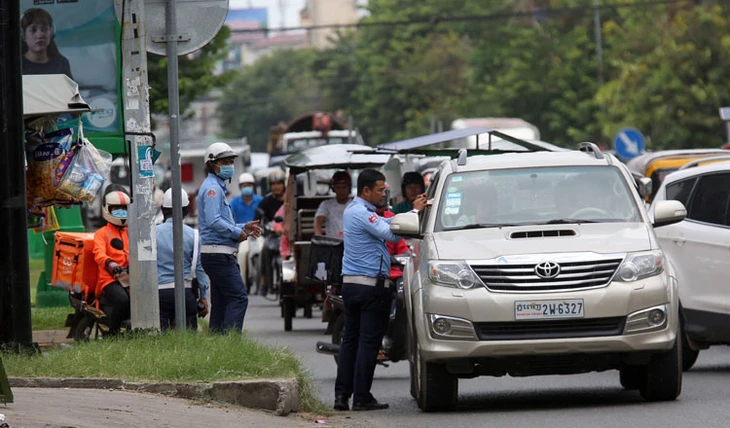
The Cambodian government has decided to temporarily suspend road traffic violation fines amid soaring fuel prices that have exceeded 45,000 riel per liter.
On March 26, a spokesperson for the Cambodian Ministry of Interior announced the government’s decision to temporarily suspend fines for road traffic violations.
This move aims to alleviate the financial burden on citizens as fuel prices surge due to the Middle East conflict.
The spokesperson stated: “This measure is to avoid placing additional pressure on drivers, who are already bearing the brunt of the sharp increase in fuel costs.”
During the suspension period, traffic police will still be deployed on roads to guide and remind the public to comply with regulations and manage congestion during peak hours. Authorities will also continue to conduct alcohol tests and control weapons and explosives during night patrols.
The decision was made in the context of prices for gasoline, diesel, and liquefied petroleum gas (LPG) having increased by 41.5%, 84%, and 60% respectively since before the outbreak of the Middle East conflict.
In the price adjustment on March 26, the Cambodian Ministry of Commerce announced that the price of regular gasoline rose to 5,450 riel per liter, diesel increased to 7,100 riel per liter, and LPG is currently priced at 3,200 riel per liter.
Last week, the Cambodian government began reducing import taxes on petroleum products. As it has not yet been able to exploit offshore oil reserves, Cambodia remains entirely dependent on imported fuel.
Thailand has confirmed it has received consent from Phnom Penh and will begin constructing a fence along a section of the border with Cambodia starting next month to enhance security.
Cambodia
Cambodia is a Southeast Asian nation best known for the magnificent Angkor Wat temple complex, the world’s largest religious monument and the heart of the powerful Khmer Empire from the 9th to 15th centuries. Its more recent history includes the devastating Khmer Rouge regime in the 1970s, but today it is a constitutional monarchy with a rich cultural heritage centered around Theravada Buddhism and ancient Hindu influences.
Phnom Penh
Phnom Penh is the capital and largest city of Cambodia, founded in 1372 at the confluence of the Mekong, Tonlé Sap, and Bassac rivers. It became the national capital in the 15th century after the fall of Angkor, and later served as the center of French colonial administration and the tragic Khmer Rouge regime in the 1970s. Today, it is a vibrant, rapidly developing city known for its historic Royal Palace, poignant museums, and bustling riverfront.
Middle East
The term “Middle East” refers to a transcontinental region centered on Western Asia and parts of North Africa, historically known as the “Cradle of Civilization” for the rise of ancient Mesopotamian, Egyptian, and Persian empires. It is the birthplace of major world religions—Judaism, Christianity, and Islam—and has been a central crossroads for trade, culture, and geopolitical influence for millennia. In the modern era, its vast oil reserves and complex political dynamics continue to shape global affairs.
Cambodian Ministry of Interior
The **Cambodian Ministry of Interior** is the government ministry responsible for internal security, national police, civil administration, and local governance. Historically, it was established during the French protectorate in the late 19th or early 20th century and has played a central, though sometimes controversial, role in maintaining public order through various political regimes, including the Kingdom of Cambodia today.
Cambodian Ministry of Commerce
The Cambodian Ministry of Commerce is a government institution responsible for regulating trade, investment, and commercial policy in Cambodia. It was officially re-established after the fall of the Khmer Rouge regime, playing a key role in the country’s post-conflict economic reconstruction and its integration into global trade systems like ASEAN and the WTO.
Thailand
Thailand is a Southeast Asian nation with a rich history dating back to ancient kingdoms like Sukhothai and Ayutthaya, which established its distinctive culture and Theravada Buddhist traditions. Known as Siam until 1939, it is notable for being the only country in the region never colonized by a European power. Today, it is celebrated globally for its ornate temples, vibrant cuisine, tropical beaches, and bustling cities like Bangkok.
Phnom Penh
Phnom Penh is the capital and largest city of Cambodia, founded as a royal capital in 1434. It is a major cultural and economic hub, home to significant sites like the Royal Palace and the National Museum, though its modern history was profoundly shaped by the tragic Khmer Rouge regime in the 1970s. Today, it is a vibrant, rapidly developing city situated at the confluence of the Mekong, Tonlé Sap, and Bassac rivers.
Cambodia
Cambodia is a Southeast Asian nation best known for the magnificent Angkor Wat temple complex, the world’s largest religious monument, which was the heart of the powerful Khmer Empire from the 9th to 15th centuries. Its more recent history includes the devastating Khmer Rouge regime in the 1970s, but today it is a constitutional monarchy with a rich cultural heritage centered around Theravada Buddhism and its ancient temples.