Gifting tea during the Spring Festival is a common choice for consumers visiting friends and relatives. Major tea companies have always prioritized Spring Festival sales as a key part of their annual marketing strategy. As the festival approaches, competition in the tea gift market has reignited. Major tea companies are launching distinctive New Year tea gift sets, with competition heating up across the board—from cultural collaborations and zodiac themes to e-commerce livestreams.
Industry insiders believe that as competition in the tea market intensifies, major tea companies are shifting towards product value upgrades focused on « simplicity, practicality, and cultural depth. » In this context, Xiaoguantea, as a modern tea brand, has chosen a path of differentiation by tying itself to traditional cultural IPs—deeply collaborating with Mount Wutai to launch the « All Wishes Fulfilled » New Year tea gift series. This transforms cultural symbols into product competitiveness, aiming to seize the initiative during the Spring Festival sales period.
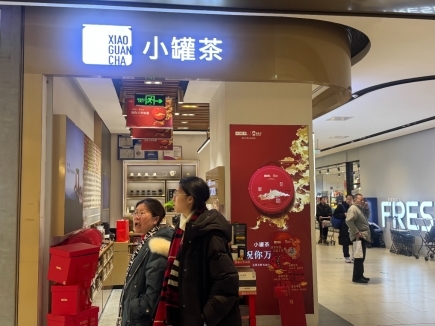
Caption: A Xiaoguantea offline store.
Xiaoguantea Partners with Mount Wutai for Festival Gifts
Recently, Xiaoguantea entered into a deep cultural collaboration with Mount Wutai in Shanxi, a UNESCO World Heritage site, launching a New Year tea gift series centered around the « All Wishes Fulfilled » gift box.
It is understood that this collaboration uses « All Wishes Fulfilled » as its core concept, integrating Mount Wutai’s millennia-old culture of peace, auspiciousness, wisdom, and good fortune into the product design for innovative expression. This aligns deeply with Xiaoguantea’s brand positioning as « Modern Chinese Tea. »
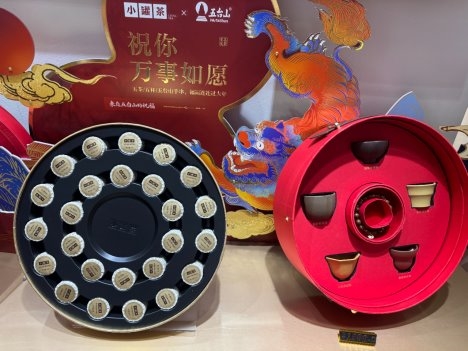
Caption: The « All Wishes Fulfilled » gift box from the Xiaoguantea and Mount Wutai collaboration.
The Xiaoguantea « All Wishes Fulfilled » gift box contains Five Blessings Complete Tea (5g x 100 cakes), Five Blessings Auspicious Cups (5 pieces), and a Six Paths Wood Good Fortune Bracelet (1 piece), priced at 1500 yuan. The Five Blessings Complete Tea includes five types of tea: Da Hong Pao (compressed tea), Pu’er (ripe tea), Shou Mei (compressed white tea), Osmanthus Liubao Tea (compressed flavored tea), and Bingdao White Tea (compressed white tea).
« All Wishes Fulfilled » is the New Year’s blessing Xiaoguantea wishes to convey to consumers through Mount Wutai. This gift box combines « tea, ware, and bracelet, » each with its own symbolic meaning. The Five Blessings Complete Tea signifies the fulfillment of all matters; the Five Blessings Auspicious Cups symbolize receiving blessings from all directions; and the Six Paths Wood Good Fortune Bracelet is meant to keep auspiciousness and good luck close at hand.
Beyond the « All Wishes Fulfilled » gift box, Xiaoguantea’s Spring Festival offerings also include the Wutai Gathers Fortune Assorted Tea Set (covering multi-flavor sampling and daily gifting), the New Year Grand Gift Box (meeting the demand for « large quantity and good value » scenarios like family reunions and corporate gifts), the Fortune and Longevity Gift Box and the Universal Fortune Gift Box (serving as thematic, lightweight gifting options), and the Good Luck Travels With You Gift Box (exclusive to e-commerce), among other products, catering to various consumption scenarios.
On Xiaoguantea’s official flagship stores on JD.com and Tmall, the « 2026 New Year Products Zone » in the middle of the page features not only the same Spring Festival gift sets available in offline stores but also the e-commerce-exclusive Good Luck Travels With You Gift Box.
Covering Multiple Price Points, Scenarios, and Demographics
As a modern tea brand, why did Xiaoguantea choose to collaborate with Mount Wutai for its Spring Festival gifts? Can this « combo strategy » help it stand out in the competitive Spring Festival tea market?
In fact, the Spring Festival has always been highly valued by major tea companies. Industry insiders note that the tea industry has three peak sales seasons: when spring tea is released, the Mid-Autumn Festival, and the Spring Festival. Spring Festival tea sales account for 35