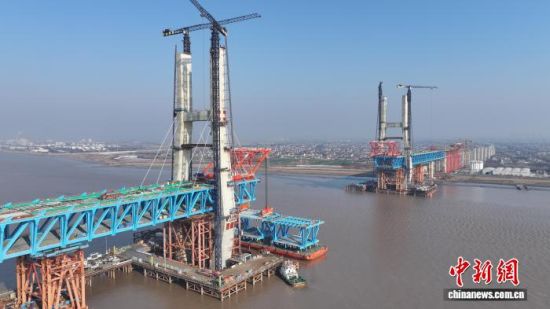
The first section of steel girder for the main navigation channel of the Chongqi Rail-Road Yangtze River Bridge on the Shanghai-Chongqing-Chengdu High-Speed Railway V project was precisely installed into position on the 24th. This marks the official commencement of the main navigation channel lifting operations for this world’s largest span ballastless track rail-road cable-stayed bridge. The main channel lifting work is expected to be completed by the end of May this year, leading to the closure of the bridge. The start of this critical phase signifies that the controlling project of the national “Eight Vertical and Eight Horizontal” high-speed railway corridor along the Yangtze River has entered a crucial final sprint stage.
The steel girder lifting for the bridge’s main navigation channel is divided into 13 rounds. All steel girders are fabricated in factories, transported by waterborne vessels to the pre-assembly yard on the south bank of the bridge for lifting and assembly, and then transported to the construction site in 13 rounds for installation using the single-cantilever erection method. Unlike the earlier non-navigation channel lifting operations, this main channel work has a greater impact on vessel traffic in the waterway. The first six lifting operations will adopt a “one-way channel closure” mode, while the latter seven will use a “full closure” mode. The operations involve long construction periods, numerous working vessels, and extremely high precision requirements. Compounded by complex hydrological and meteorological conditions such as significant tidal fluctuations, frequent winter cold waves, and strong instantaneous winds, the safety risks are exceptionally high.
To fully support and ensure the smooth progress of this “millimeter-level” incremental launching project, relevant maritime authorities planned ahead and made meticulous arrangements, establishing a full-chain support system through “technology empowerment + precise services”. First, an emergency linkage system was set up to ensure efficient and orderly construction. Second, comprehensive consideration was given to mitigate risks through consultation. By convening meetings in advance with personnel from the construction project department, on-site operating vessels, and surrounding emergency response units to discuss the operation plan, the safety, efficiency, and order of the construction work were ensured. Third, measures were fully implemented, utilizing technology to guarantee safety. Fourth, emphasis was placed on emergency preparedness, creating a “15-minute emergency response circle” through coordination.