Thailand, as a key manufacturing and trade hub in Southeast Asia, is attracting an increasing number of Chinese manufacturing enterprises to invest and establish operations. However, common pain points in cross-border logistics such as complex customs clearance, opaque processes, and difficult last-mile delivery often leave companies facing insufficient supply chain efficiency and operational risks. Leveraging years of experience serving manufacturing enterprises and localized capabilities in Thailand, a dedicated end-to-end “South China/East China – Thailand” route has been officially launched, providing companies with a one-stop supply chain solution covering customs clearance, transportation, warehousing, and distribution.
By integrating three major trunk line resources—sea, land, and air freight—an extensive, well-connected, and flexibly responsive cross-border logistics network has been established, supporting companies in flexibly configuring transportation plans based on cargo volume, delivery timelines, and cost requirements.
1. Sea Freight Express Port-to-Port
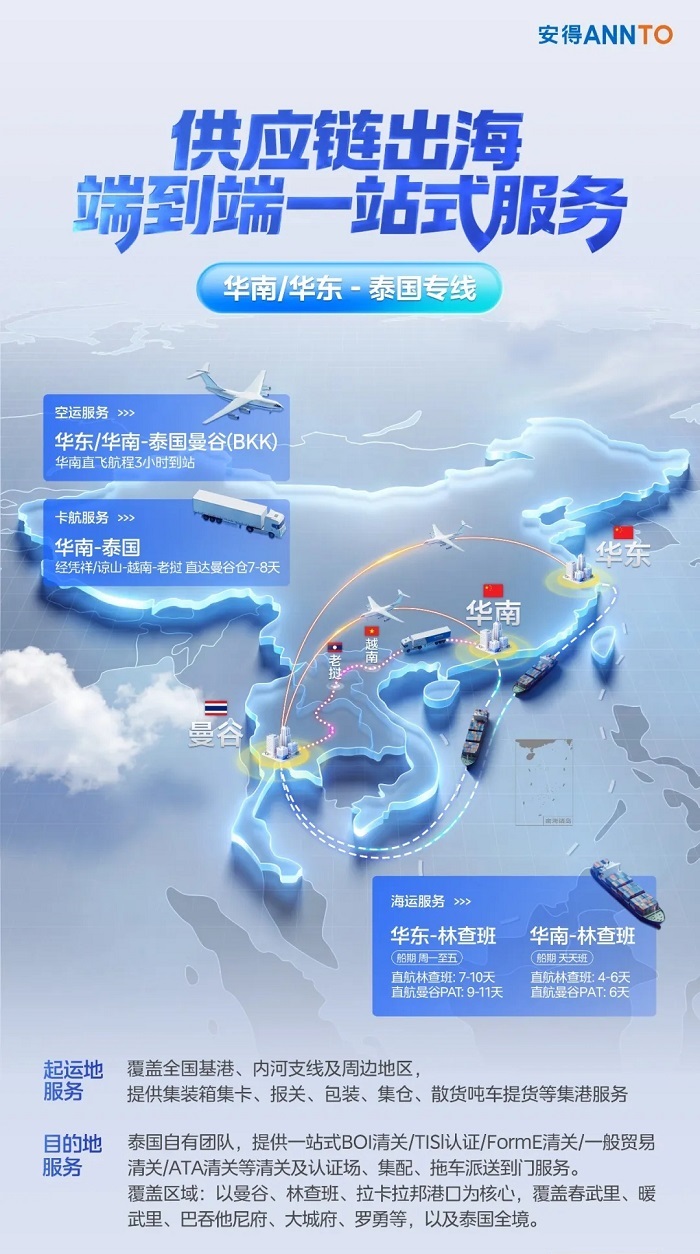
South China – Laem Chabang: Daily direct sailings, 4–6 days direct to Laem Chabang, approximately 6 days to PAT Bangkok;
East China – Laem Chabang: Monday to Friday sailings, 7–10 days direct to Laem Chabang, approximately 9–11 days to Bangkok.
Supports barge connections within the Pearl River Delta and Yangtze River Delta, as well as road-rail and sea-rail intermodal services, with an extensive cargo collection network.
2. Direct Land Freight Door-to-Door
South China – Bangkok, Thailand: Via Pingxiang/Dongxing ports, traversing Vietnam and Laos, 7–8 days direct to Bangkok warehouse;
East China – Bangkok, Thailand: Same route, 9–10 days delivery.
Also applicable for less-than-truckload (LTL) land freight, providing a cost-effective land channel for e-commerce and LTL cargo.
3. Air Freight Express Station-to-Station
South China/East China – Bangkok (BKK), with direct flights from South China taking only about 3 hours, meeting urgent, high-priority cargo needs.

① Customs Clearance & Certification: Supports all types of customs clearance services including BOI clearance, TISI certification, Form E, general trade, ATA temporary import/export, and more;
② Warehousing & Distribution: Operational nodes are located in core logistics areas such as Bangkok, Laem Chabang, and Lat Krabang, providing services like container stripping, cargo sorting, and temporary storage;
③ Last-Mile Coverage: Centered in Bangkok, services cover surrounding industrial areas like Nonthaburi, Pathum Thani, Ayutthaya, and Rayong, extending nationwide across Thailand.

Building on years of deep supply chain experience serving the manufacturing sector, this dedicated Thailand route not only offers diverse transportation capabilities and a local service team but has also established systematic safeguards in areas like customs compliance, process visibility, and end-to-end control. Companies can utilize the digital system to achieve full transparency in management from the factory end to the destination in Thailand, significantly reducing operational risks and hidden costs in cross-border logistics.
As China-ASEAN economic and trade cooperation continues to deepen, efforts will continue to improve the supply chain service layout in Thailand and the broader Southeast Asia region. Through standardized, professional, and digitalized end-to-end solutions, the aim is to support Chinese manufacturing enterprises in their steady overseas expansion, achieving dual enhancement in supply chain efficiency and competitiveness during their internationalization journey.