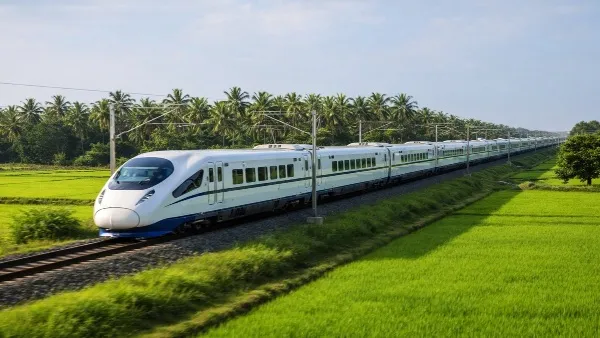
Bengaluru to Chennai bullet train will reach in 1.15 hours, journey will pass through 3 tunnels.
Bengaluru Chennai Bullet Train: The Chennai-Bengaluru High-Speed Rail Corridor is set to completely transform the transportation landscape of South India. The National High-Speed Rail Corporation (NHSRCL) has finalized the shortest and most technically suitable route for this 306-kilometer-long project after studying four potential alignments. This corridor will be primarily elevated, while approximately 26-30 km will pass through underground tunnels.
A 12 km long tunnel is proposed between Whitefield and Baiyappanahalli in Bengaluru. An 11.5 km tunnel will be built in the Mogili Ghat area of Chittoor, Andhra Pradesh, while about 2.5 km within Chennai city will remain underground. Construction work inside the tunnel is considered extremely challenging.
Bengaluru Chennai Bullet Train: 8 Stations to be on the Route
A total of 8 major stations will be built on this line: Baiyappanahalli, Whitefield, Kodihalli, Hudukula, Rampurum, Parandur, Poonamalli, and Chennai Central. A maintenance depot will also be developed near Kodihalli.
– The biggest benefit of the project will be the reduction in travel time. Currently, the Vande Bharat Express takes about four and a half hours to travel from Chennai to Bengaluru. The bullet train will be able to cover this distance in just 1 hour and 13 minutes.
– The trains will be designed for a maximum speed of 350 km/h and will operate at 320 km/h.
Bengaluru Chennai Bullet Train News: Work to be Done in Phases
In the General Budget 2026-27, this corridor was included among the country’s seven major high-speed rail projects. Work in the first phase will only be on the Chennai-Bengaluru section, while the Mysuru extension will be taken up in the second phase. The survey using LiDAR technology has been completed and the land acquisition process is now set to begin.
Bullet Train Project: To Become the Hub of the South India High-Speed Diamond
Experts believe this corridor will become a crucial part of the ‘South India High-Speed Diamond,’ which in the future will connect Chennai, Bengaluru, and Hyderabad with an ultra-fast network. This will provide a major boost to the IT corridor, manufacturing hubs, and the real estate sector. The station near Parandur Airport will strengthen air-rail connectivity and provide direct benefits to millions of passengers.
Chennai-Bengaluru High-Speed Rail Corridor
The Chennai-Bengaluru High-Speed Rail Corridor is a proposed bullet train project in India, designed to connect the major southern cities of Chennai, Tamil Nadu, and Bengaluru, Karnataka. While still in the planning and feasibility study stages, the corridor aims to significantly reduce travel time between the two economic hubs to approximately two hours. Its history is part of India’s broader national high-speed rail initiative, inspired by the ongoing Mumbai-Ahmedabad corridor, to modernize the country’s transportation infrastructure.
Whitefield
Whitefield is a town in Greater Manchester, England, historically part of Lancashire. It grew significantly during the Industrial Revolution due to its textile mills and later became a residential suburb. The area’s name is believed to derive from the “white field” of a medieval farm or from the local Methodist preacher George Whitefield, who preached there in the 18th century.
Baiyappanahalli
Baiyappanahalli is a major suburb in eastern Bengaluru, India, best known as the location of the city’s first and largest operational metro depot for the Bengaluru Metro (Namma Metro). Historically a peripheral village, its modern identity is defined by this critical transit hub, which opened in 2011 as part of the metro’s inaugural Reach 1, facilitating the system’s expansion and the area’s rapid urban development.
Mogili Ghat
Mogili Ghat is a historic bathing ghat (steps leading to a river) located on the banks of the Godavari River in Rajahmundry, Andhra Pradesh, India. It is traditionally believed to have been constructed in the 19th century by a local zamindar (landowner) named Mogili, serving as a vital site for religious rituals, festivals, and daily life for the local community. Today, it remains a prominent cultural and spiritual landmark, especially during the Godavari Pushkaram, a major Hindu pilgrimage festival.
Chittoor
Chittoor is a city in the southern Indian state of Andhra Pradesh, historically significant as part of various South Indian dynasties like the Pallavas, Cholas, and Vijayanagara Empire. It is best known today as the gateway to the revered hill temple of Tirumala Venkateswara at Tirupati, one of the world’s most visited religious sites. The region’s history is deeply intertwined with temple administration and has been a prominent cultural and pilgrimage center for centuries.
Chennai Central
Chennai Central, officially known as Puratchi Thalaivar Dr. M.G. Ramachandran Central Railway Station, is the primary railway terminus in Chennai, India. Opened in 1873, its iconic red-brick Gothic-style building was designed by British architect George Harding and has served as a major gateway to South India for over 150 years. It remains one of the busiest and most historically significant railway hubs in the country.
Parandur Airport
Parandur Airport is a proposed greenfield international airport project located near the village of Parandur in Tamil Nadu, India. It is intended to serve the Chennai metropolitan region, aiming to decongest the existing Chennai International Airport. The project, announced by the state government, has a history of local opposition and environmental concerns regarding its impact on water bodies and agricultural land in the area.
South India High-Speed Diamond
“South India High-Speed Diamond” refers to a proposed high-speed rail corridor project in India, often called the “Diamond Quadrilateral,” which aims to connect the major metropolitan cities. While not a historical site, its concept is part of India’s future infrastructure plans to boost connectivity and economic growth across regions, including in South India. The project draws inspiration from the success of high-speed networks in other countries and is envisioned to transform long-distance travel on the subcontinent.