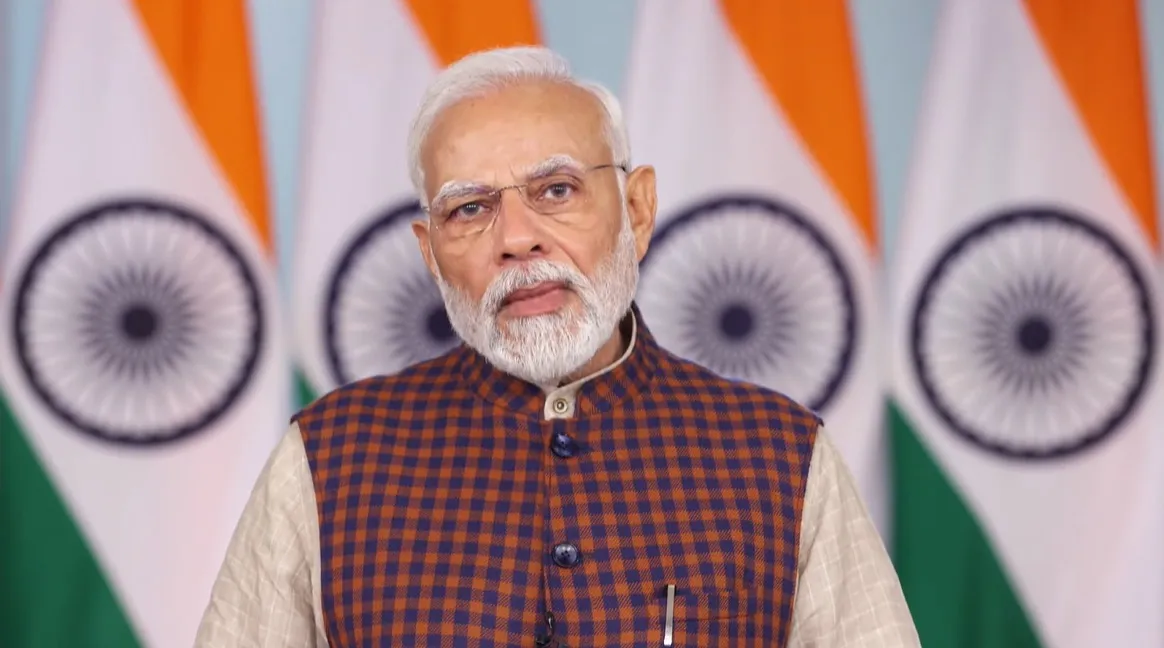
Prime Minister Narendra Modi has expressed deep satisfaction following the agreement on the framework of a historic interim trade deal between India and the United States.
The Prime Minister described this achievement as a new chapter in the economic relations of the two countries and thanked US President Donald Trump for his personal cooperation and commitment.
The Prime Minister said that this agreement will not only strengthen trade relations between the two countries but will also give new momentum to the Make in India campaign. He expressed confidence that this deal will open new doors of international opportunities for India’s farmers, entrepreneurs, small and medium industries, startups, and fishermen.
Prime Minister Modi shared that as India moves forward with the resolve to become a developed India, such global partnerships will play a crucial role in laying the foundation for the future, empowering citizens, and bringing shared prosperity.
This agreement is especially significant because through it, the US has immediately eliminated the additional 25 percent punitive tariff imposed on India. Notably, this additional tariff was imposed in the context of oil purchases from Russia.
For India, the total tariff has now been reduced to 18 percent, while the duty on aircraft and related equipment has been completely eliminated.
US President Donald Trump, issuing an executive order, clarified that India has committed to stopping direct or indirect imports of oil from Russia and will now focus on the US for its energy product needs.
President Trump, appreciating the steps taken by India, said that India has made significant efforts to align sufficiently with the US on matters of national security, foreign policy, and the economy.
Based on this, the decision was taken to remove the additional tariffs on goods imported from India. A major feature of this agreement is that India has ensured the protection of its sensitive agricultural and rural interests.
Under the agreement, India’s key agricultural products, such as wheat, millet, dry cereals, and red sorghum used for animal feed, have been fully protected. Furthermore, nuts, fresh and processed fruits, soybean oil, and dairy products have also been kept out of the scope of this deal.
India has ensured that its dairy and spice categories are not negatively impacted by foreign competition. This shared strategy to enhance defense cooperation and ensure energy security over the next 10 years has given a new direction to the future relations of the two countries.
India
India is a vast South Asian nation with one of the world’s oldest continuous civilizations, dating back over 5,000 years to the Indus Valley. Its history is marked by the rise of major religions like Hinduism and Buddhism, successive empires, Mughal rule, and British colonization before gaining independence in 1947. Today, it is a densely populated and diverse republic renowned for its rich cultural heritage, including countless historical monuments, diverse languages, and vibrant traditions.
United States
The United States is a federal republic founded in 1776 after declaring independence from Great Britain, with its modern government established by the Constitution in 1789. Culturally, it is a vast and diverse nation shaped by waves of immigration, indigenous heritage, and its development as a global economic and political power. Key historical sites include landmarks like Independence Hall, the Statue of Liberty, and the National Mall, which reflect its revolutionary origins, ideals of liberty, and democratic evolution.
Make in India
“Make in India” is not a physical place or cultural site, but a major national initiative launched by the Indian government in 2014 to transform India into a global manufacturing and design hub. The program aims to attract foreign investment, foster innovation, and create jobs by promoting key sectors such as automobiles, electronics, and renewable energy. Historically, it represents a strategic shift in India’s economic policy to boost domestic production and enhance the country’s integration into global supply chains.
Russia
Russia is the world’s largest country by area, spanning Eastern Europe and Northern Asia. Its history is marked by the rise and fall of the Tsarist Empire, the 1917 Bolshevik Revolution which established the Soviet Union, and its post-1991 emergence as the Russian Federation. Culturally, it is renowned for its vast contributions to literature, classical music, ballet, and iconic architecture, from the onion domes of St. Basil’s Cathedral in Moscow to the palaces of St. Petersburg.
wheat
Wheat is not a specific place or cultural site, but a foundational cereal grain domesticated around 10,000 years ago in the Fertile Crescent. Its cultivation and trade fueled the rise of ancient civilizations, and it remains a staple food and powerful cultural symbol of sustenance and agriculture across the globe.
millet
“Millet” is not a specific place or cultural site, but a group of small-seeded cereal grains that have been cultivated for thousands of years. Historically, it was a staple food in ancient civilizations across Asia and Africa, such as in China, India, and the Sahel region. Its cultivation represents one of the earliest agricultural practices and remains vital for food security in many arid regions today.
red sorghum
“Red Sorghum” is not a physical place or cultural site, but the title of a landmark 1987 Chinese novel by Mo Yan and a subsequent film. The story, set in rural Shandong province during the early 20th century, uses the vast sorghum fields as a central symbol of resilience, passion, and the tumultuous history of the Sino-Japanese War. It has become a powerful cultural symbol in modern Chinese literature and cinema.
soybean oil
“Soybean oil” is not a specific place or cultural site, but a widely produced edible oil derived from soybeans. Its history as a major commercial product began in the early 20th century, particularly in the United States, where industrial processing methods made it a globally dominant cooking oil and food ingredient.