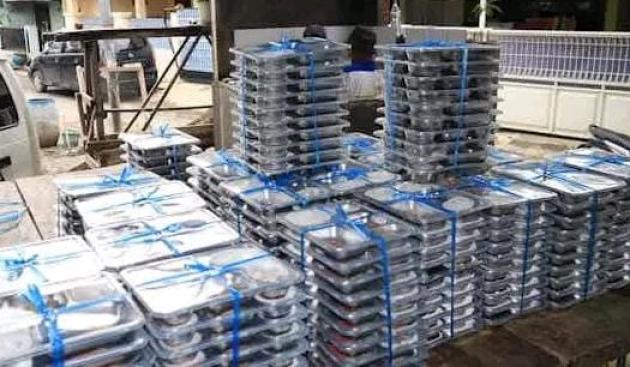
Not only draining education funds, Commission X of the House of Representatives proposes that MBG also take health and social assistance budgets.
Deputy Chairman of Commission X of the House of Representatives of the Republic of Indonesia, Lalu Hadrian, responded to the lawsuit filed with the Constitutional Court regarding the use of the education budget in the 2026 State Revenue and Expenditure Budget for the Free Nutritious Meals program.
According to Lalu, the Free Nutritious Meals program has objectives aligned with efforts to improve the quality of human resources, particularly in preventing stunting among school children.
However, he holds the view that funding for this program should not be entirely borne by the education budget allocation.
“We in Commission X of the House of Representatives certainly support the noble goal of the Free Nutritious Meals program to improve nutrition and prevent stunting in school children. This program is an important investment for the quality of future human resources,” said Lalu.
He proposed that funding for the Free Nutritious Meals program should come from cross-sectoral cooperation, including the health budget and social assistance.
According to him, this scheme can maintain a balance between government programs.
“We are of the opinion that funding for the Free Nutritious Meals program should come from more appropriate budget collaboration, not just taken from the education budget,” he stated.
Lalu hopes that the focus of the education budget remains safeguarded for the primary needs of the education sector. He considers this important so that the improvement of learning quality is not disrupted.
“The hope is that this maintains the focus and proportion of the education budget, keeping it purely for strengthening the core quality of learning, such as improving teacher competency, repairing facilities and infrastructure, scholarships, and other educational programs, so that all programs can run optimally and complement each other,” he concluded.
Previously, a group of citizens filed a lawsuit against Law Number 17 of 2025 concerning the 2026 State Budget with the Constitutional Court.
The lawsuit was registered with case number 40/PUU-XXIV/2026 and requests that the education budget not be used for the Free Nutritious Meals program.
Based on the submitted petition, the petitioners assess that the allocation of the education budget for the Free Nutritious Meals program in the 2026 State Budget reaches IDR 223 trillion, or approximately 29 percent of the total education budget of IDR 769.1 trillion.
“With such a large amount of funds being consumed by the Free Nutritious Meals program, funding for educational operations is reduced. Meanwhile, issues of inequality in access to education and teacher welfare are still inadequate to this day. There are many prospective students who cannot access basic education due to lack of means,” said the petitioner.
Commission X of the House of Representatives of the Republic of Indonesia
Commission X is a permanent committee within Indonesia’s House of Representatives (DPR) responsible for overseeing education, sports, tourism, arts, and culture. It was established as part of the legislature’s committee system to scrutinize government policies and budgets within these sectors. Its work involves evaluating ministries like the Ministry of Education and Culture to ensure alignment with national development goals.
Constitutional Court
The Constitutional Court of South Korea, located in Seoul, is the highest court for constitutional review. Established in 1988 following the democratic reforms of the Ninth Constitution, it safeguards the Constitution by reviewing legislation, impeachments, and constitutional complaints. Its creation marked a pivotal step in South Korea’s transition to a robust democratic system with strong judicial oversight.
Free Nutritious Meals program
The Free Nutritious Meals program is not a specific place or cultural site, but a social welfare initiative. Such programs, often run by governments, NGOs, or community groups, have a history of addressing food insecurity and malnutrition, particularly for vulnerable populations like children, the elderly, and low-income families. They represent a cultural commitment to public health and social support within a community.
2026 State Revenue and Expenditure Budget
The “2026 State Revenue and Expenditure Budget” is not a physical place or cultural site; it is a financial planning document. It is a government’s annual fiscal plan, outlining projected income (revenue) and planned spending (expenditure) for the year 2026. Its history is part of the ongoing, cyclical governmental process of budgeting, which varies by country but is typically rooted in laws and traditions established over decades or centuries to manage public funds.
Law Number 17 of 2025
“Law Number 17 of 2025” is not a physical place or cultural site; it is a piece of legislation. As a reference to a future law (2025 has not yet occurred), it has no established history or real-world existence. It would be a legal document outlining rules or policies set by a governing body, but its specific content and context are unknown.
2026 State Budget
The “2026 State Budget” is not a physical place or cultural site, but a government’s financial plan for a fiscal year. It is a legislative document outlining proposed revenues and expenditures, reflecting the nation’s priorities and policies for that period. Its history is part of the ongoing, annual budgetary process of the government in question.
education budget
“Education budget” is not a specific place or cultural site, but a financial allocation for educational programs and institutions. Its history is tied to the development of public education systems, with modern national budgets for education often formalized in the 19th and 20th centuries to promote literacy, workforce development, and social equity. It represents a government’s or organization’s priority and investment in human capital and future societal development.