Rahul Gandhi attacks government over Doklam issue, uproar in Lok Sabha.
X
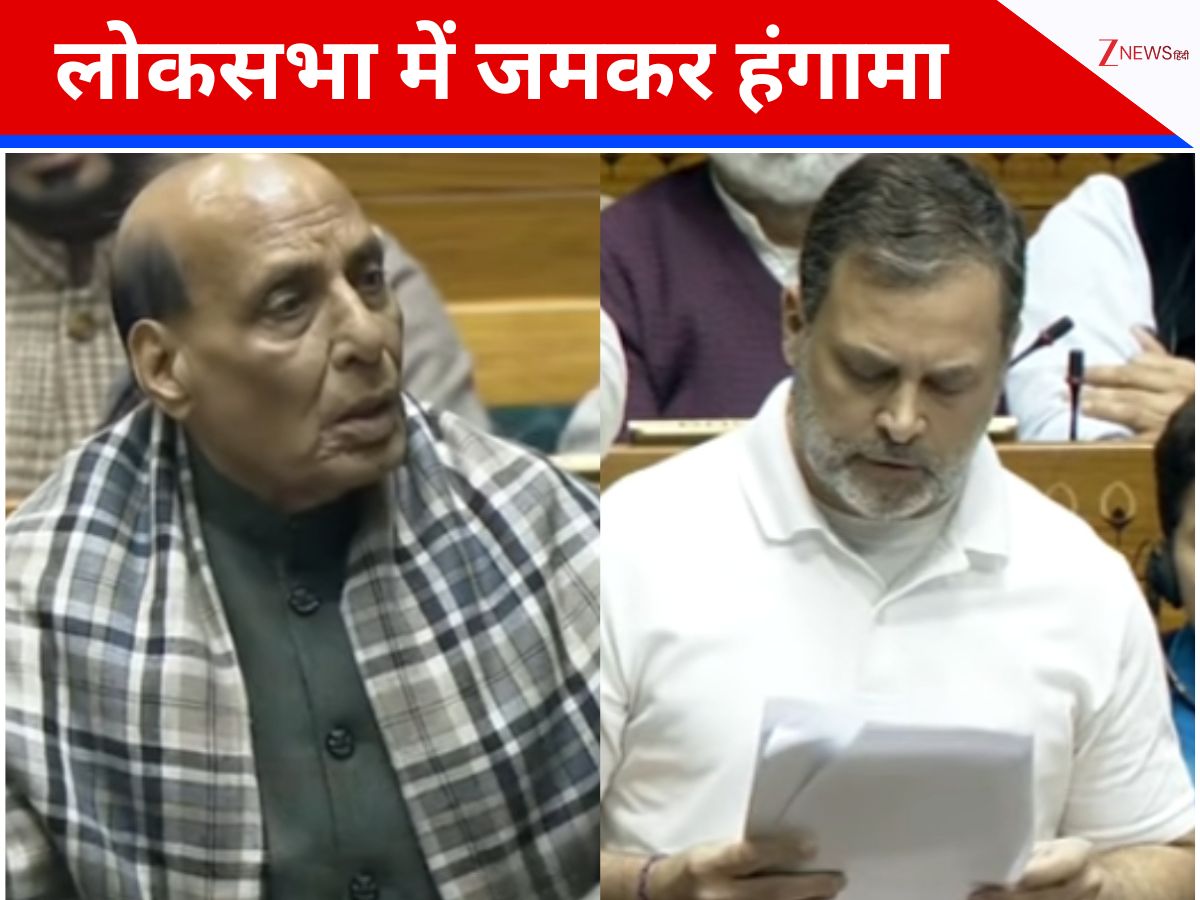
Parliament Budget Session Live: During the debate on the motion of thanks to the President’s address in the Lok Sabha, Opposition leader Rahul Gandhi launched a sharp attack on the central government, raising the issue of Chinese incursion. His speech led to a major uproar in the House. In his address, Rahul Gandhi questioned security matters related to China and criticized the government’s policies. During this, he read excerpts from a report published in a magazine, to which Defence Minister Rajnath Singh objected. Rajnath Singh said that under the rules of the House, references cannot be made to unpublished material or books that have not been published.
The Defence Minister said in the Lok Sabha that he wants the Leader of the Opposition to place the book he is quoting from on the table of the House, because the book being referred to has not been published yet. He clarified that debate in the House can only be conducted within the framework of the rules.
China-related matter is sensitive, debate should be allowed: Akhilesh
Amid this controversy, Samajwadi Party MP Akhilesh Yadav supported Rahul Gandhi. He said the matter related to China is extremely sensitive and the Leader of the Opposition should be allowed to present his views on this subject. Akhilesh Yadav urged the House that there should be broad and open discussion on issues related to national security.
In the Lok Sabha, speaking in favour of the LoP, Lok Sabha, who was speaking in the context of China, Samajwadi Party MP Akhilesh Yadav says, “The matter relating to China is very sensitive. LoP, Lok Sabha should be allowed to speak.”
Meanwhile, the Union Parliamentary Affairs Minister informed the House that the Speaker had already clarified that quoting articles from magazines or newspapers is not permitted in the Lok Sabha. He said the proceedings and debate of the House will be conducted only according to the established rules and procedures.
In Lok Sabha, Union Parliamentary Affairs Minister says,” The Speaker has given a ruling that articles from magazines or newspapers cannot be quoted in the House…Debate in the House should be held according to the laws.”
Lok Sabha Proceedings Adjourned
In his clarification, Rahul Gandhi said the sources he quoted are credible and include excerpts from the unpublished memoirs of a former Army Chief, General MM Naravane. However, the government side termed this a violation of the House rules. During this, Rahul Gandhi questioned again, asking what is in it that is making the government so uncomfortable. He said if the government is not afraid, then he should be allowed to read it.
LoP, Lok Sabha, Rahul Gandhi says,” The Defence Minister, Home Minister and the Prime Minister raise questions on our party, party leaders, and our nationalism. This article writes about the PM’s character…This is neither about China, nor the PM…”
During this, Leader of the Opposition in the Lok Sabha Rahul Gandhi said that the Defence Minister, Home Minister, and Prime Minister question our party, party leaders, and our nationalism. This article writes about the PM’s character. Due to intense debate in the House, Lok Sabha proceedings have been adjourned until 3 PM.
Lok Sabha
The Lok Sabha is the lower house of India’s bicameral Parliament, located in New Delhi. Established by the Constitution of India in 1952, it is the primary legislative body where members are directly elected by the people. Its history is tied to India’s independence, succeeding the Constituent Assembly and operating from the iconic Sansad Bhavan (Parliament House), a heritage building from the British colonial era.
President
“President” is not a specific place or cultural site. It is a title for the head of state or government in many countries, most notably the President of the United States. The role and its history vary by nation, but in the U.S., the presidency was established by the Constitution in 1787, with George Washington becoming the first president in 1789.
Parliament
Parliament refers to the supreme legislative body in many countries, most famously the Parliament of the United Kingdom. Its origins trace back to the 13th century with the Model Parliament of 1295, establishing a bicameral system of the House of Lords and House of Commons. Today, it serves as the primary institution for debating and passing laws, located at the Palace of Westminster in London.
House
The concept of a “house” as a cultural site is universal, representing the fundamental human structure for dwelling, family life, and shelter. Its history spans from prehistoric huts and ancient Roman *domus* to the varied architectural styles seen globally today, constantly evolving with materials, technology, and social needs. More than just a building, the house is a profound symbol of privacy, identity, and community across all cultures.
General MM Naravane
“General MM Naravane” refers to General Manoj Mukund Naravane, a distinguished former Chief of the Army Staff of the Indian Army (serving from 2019 to 2022), not a physical place or cultural site. His career was marked by significant leadership during periods of heightened tension along India’s borders, and he played a key role in modernizing the army’s operational strategies. Therefore, his legacy is one of military service and strategic command rather than a location with a architectural or historical site history.
Defence Minister
“Defence Minister” is not a specific place or cultural site. It is a high-ranking government position in charge of a nation’s military and defense policy. The role and title have existed in various forms in different countries for centuries, evolving with the development of modern statehood and armed forces.
Home Minister
“Home Minister” is not a specific place or cultural site, but a political title used in many Commonwealth countries, most notably India, for the government official responsible for internal security and domestic policy. The role has a significant history; in India, for example, the Ministry of Home Affairs was established in 1947 after independence, with Sardar Vallabhbhai Patel serving as the first Deputy Prime Minister and Home Minister, crucial in integrating the princely states. Therefore, it refers to a governmental office and its incumbent, rather than a physical location for tourism.
Prime Minister
“Prime Minister” is not a specific place or cultural site, but a political office. The role of a head of government, often called Prime Minister, originated in the United Kingdom in the 18th century, with Sir Robert Walpole widely considered the first. The title and parliamentary system have since been adopted by many countries around the world.

)