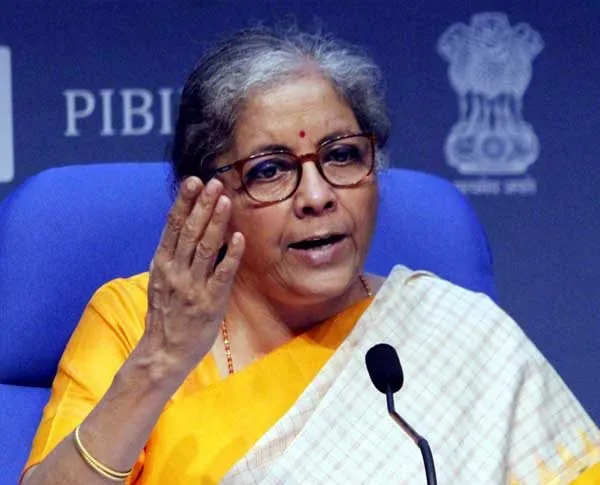
Finance Minister presented a budget of ₹53,47,315 crore for the fiscal year 2026-27 in Parliament on Sunday. The budget aims to strengthen the economy against global challenges and steer it towards a developed India, setting a target of ₹17,14,523 crore in capital expenditure for manufacturing, economic, and social infrastructure development.
The budget provides no relief in personal income tax rates but has reduced the Minimum Alternate Tax (MAT) rate for industries from 15 percent to 14 percent. Detailed measures to simplify processes and compliance for investors and importers have been announced.
In her speech lasting one hour and 25 minutes, the Finance Minister set a target to limit the fiscal deficit to 4.3 percent of Gross Domestic Product (GDP), despite increasing capital expenditure in the budget. The fiscal deficit for the current financial year is 4.4 percent, compared to the budget estimate of 4.5 percent.
Following the budget speech, stock markets witnessed a sharp decline, with the BSE Sensex at one point falling by 2300 points, though it later recovered significantly. Under a plan to limit debt relative to GDP from the current fiscal year, a target has been set to keep the debt-to-GDP ratio around 50 percent by 2030-31, with an estimate of 55.6 percent for 2026-27.
It was stated that reducing government debt will increase credit availability for priority sectors, lower interest payments for the government, and help boost production.
The acceptance of the 16th Finance Commission’s report was announced, stating that states’ share in the Centre’s divisible pool of taxes will remain at 41 percent.
It was noted that despite global challenges, India’s growth rate has remained around seven percent, enabling the government to successfully mobilize resources for development and welfare. It was emphasized that India must remain connected to the global market to continue benefiting from export markets, foreign capital, and technology.
Gratitude was expressed to the public for their trust in the government, with the stated goal being to realize people’s aspirations and ensure economic growth reaches the youth, farmers, the poor, women, and other needy sections of society.
Presenting this first budget prepared in the new government office area, it was described as inspired by the youth, with valuable suggestions received from the public during its preparation.
The budget was described as focused on three duties of the government: the first duty being to boost economic growth, the second to empower people to fulfill their aspirations, and the third to advance social welfare schemes in line with the principle of collective development.
The government’s commitment to reforming policies and programs was underscored, noting that over 350 reforms, including in Goods and Services Tax, have been implemented since last August’s Independence Day address. New initiatives were announced to incentivize sectors like bio-pharma, semiconductors, electronic components, rare minerals, and textiles to accelerate economic growth.
A proposal was made to revive over 200 traditional industrial clusters and develop four new economic zones. Additionally, it was stated that with the assistance of public sector undertakings, two high-tech tool rooms will be established to design, test, and manufacture high-precision components at low cost for building capacity in capital goods manufacturing. A scheme for equipment manufacturing for the manufacturing and infrastructure sector was also announced.
For infrastructure development in Tier-2 and 3 cities, announcements included a new freight transport corridor between Dankuni in West Bengal and Surat in Gujarat, and the establishment of shipbuilding facilities for domestic waterways in Varanasi and Patna. An allocation of two thousand crore rupees was proposed to reduce carbon emissions in sectors like power, steel, aluminum, and textiles.
The budget announced the launch of a new National Fiber Mission, the expansion of the Samarth scheme for handicrafts and handlooms, and the Mahatma Gandhi Gram Swaraj Yojana for Khadi and village industries. Several initiatives were announced to simplify and enhance financing access for the Micro, Small, and Medium Enterprises sector.
To prepare the banking sector for future needs, the formation of a high-level committee was announced. This also includes a proposal for restructuring the Power Finance Corporation and the Rural Electrification Corporation.
To help municipal corporations raise funds for development, an incentive of ₹100 crore was announced for municipal bond issues of up to ₹1,000 crore. The existing incentive scheme for issues up to ₹200 crore will continue.
Under the second duty, initiatives were announced to give a new dimension to the service sector. These include measures in education, skill development, medical services