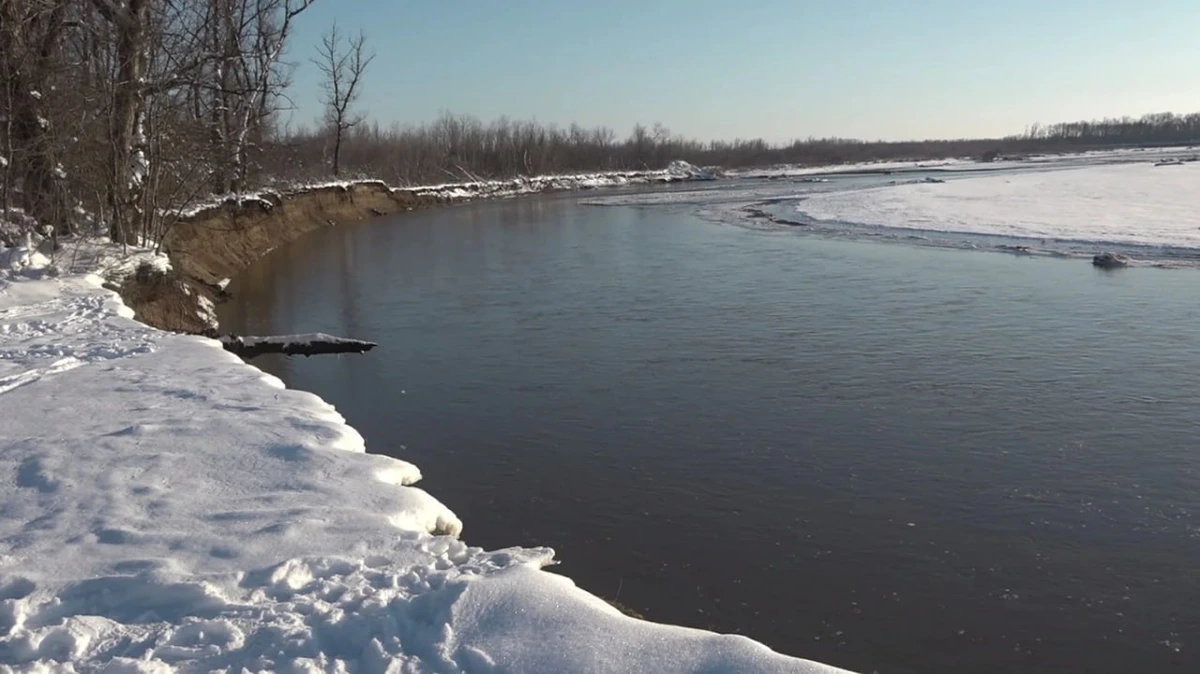
Meltwater destroyed the bank reinforcement on the Belaya River in the village of Velikovechnoye, creating a threat to nearby residential houses.
The river began eroding the shoreline near the settlement after the snow melted. A powerful water flow destroyed a previously built gabion dam reinforced with pins.
A new snowfall has replaced the first snow wave. However, weather forecasters promise a rapid warming, and with it — a new threat of rising water levels in rivers and reservoirs.
A commission was initiated to inspect the site. The group included representatives from the regional ministry of natural resources, the Kuban Basin Water Management Authority, the Belorechensky Department for Civil Defense and Emergency Situations, as well as deputy heads of the district and settlement administration.
Specialists examined the erosion site and assessed the situation. The commission’s report recorded the urgent need for measures to divert the flow of the Belaya River away from the eroding section, as local residents’ houses are in immediate proximity to the danger zone.
Regional experts promised to minimize the time for reviewing the issue and obtaining approvals to quickly begin work. The situation is under the control of the authorities.
Residents of the Krasnodar Krai had been warned about rising water levels in rivers from January 23 to 25 due to snowmelt.
Belaya River
The Belaya River is a major waterway in Russia, flowing through the Republic of Bashkortostan. Historically significant, it served as a crucial trade and transport route for centuries and was a focal point during the region’s incorporation into the Russian state in the 16th century. Today, it is known for its scenic beauty, recreational activities, and the city of Ufa situated at its confluence with the Ufa River.
Belorechensky district
The Belorechensky District is a municipal region in Russia’s Krasnodar Krai, situated in the foothills of the North Caucasus. Historically, its development was closely tied to the expansion of the Russian Empire into the region in the 19th century, with the city of Belorechensk founded in 1862 as a Cossack settlement. Today, the area is known for its agriculture, natural landscapes, and as a gateway to the mountainous areas of Adygea.
Velikovechnoye
“Velikovechnoye” does not correspond to a widely recognized historical place or major cultural site. It is most commonly known as a village (selo) in Krasnodar Krai, Russia, and shares its name with a Cossack folk ensemble. Therefore, it lacks a prominent, documented history on a global scale.
Kuban Basin Water Management Authority
The Kuban Basin Water Management Authority is a regional administrative body in southern Russia responsible for regulating water resources in the Kuban River basin. It was established during the Soviet era to oversee irrigation, flood control, and hydroelectric projects, crucial for the agriculture and industry of the Krasnodar region. Today, it continues to manage water distribution and infrastructure for this vital economic area.
Belorechensky Department for Civil Defense and Emergency Situations
The Belorechensky Department for Civil Defense and Emergency Situations is a local administrative body in the Belorechensky District of Russia, responsible for public safety, disaster response, and civil defense coordination. Its history is tied to the development of the national Russian System of Civil Defense, evolving from Soviet-era civil defense structures to address modern emergencies and natural disasters in the region.
Krasnodar Krai
Krasnodar Krai is a federal subject and historical region in southern Russia, located on the fertile Kuban Plain between the Sea of Azov and the Caucasus Mountains. Historically part of the Kuban Cossack Host, its territory was formally incorporated into the Russian Empire in the late 18th century following conflicts with the Ottoman Empire. Today, it is a major agricultural, industrial, and tourist region, known for its Black Sea resorts like Sochi and its vibrant Cossack cultural heritage.