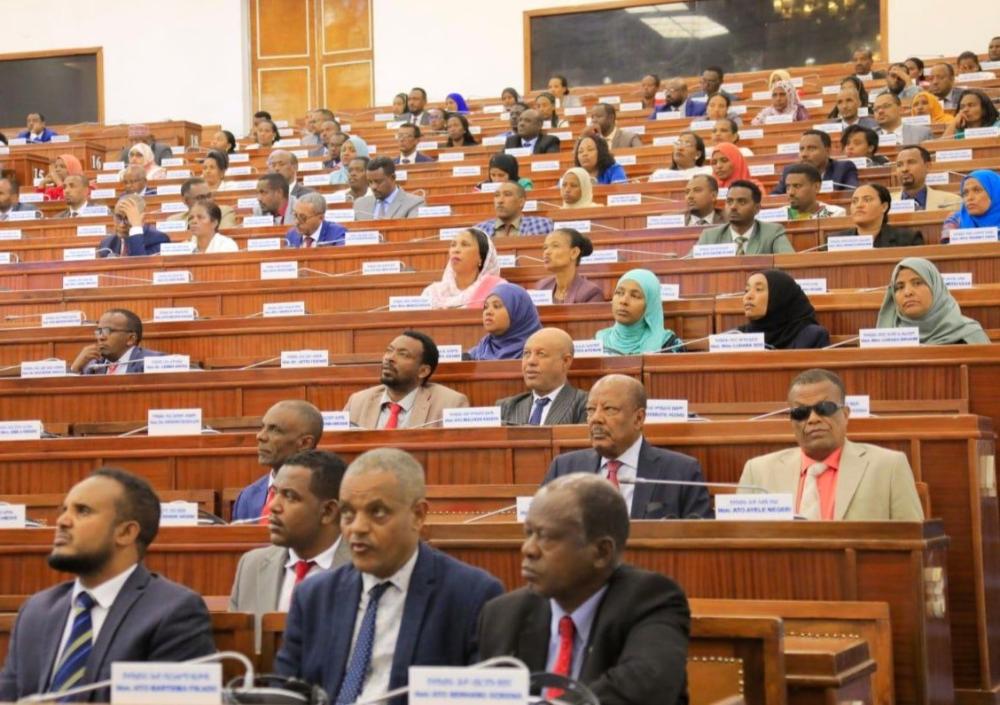
Addis Ababa — The House of People’s Representatives today approved decrees concerning the extradition of convicts and the transfer of wanted criminals to the governments of China, Brazil, and South Africa.
The extradition decrees included agreements signed between the governments of China and Ethiopia, as well as between the governments of Brazil and Ethiopia.
The agreement for the transfer of wanted persons is signed between the governments of Ethiopia and South Africa.
In endorsing the presented decrees, the Chairperson of the Standing Committee for Legal and Judicial Affairs stated that these decrees will contribute to the rehabilitation of convicts in their home countries and their reintegration into their communities.
It was added that the approved decrees are in line with international laws and also help in addressing criminal issues within legal frameworks.
Furthermore, the common legal framework will enable the enhancement of trade and investment cooperation between Ethiopia and the concerned countries, particularly China, by combating criminals who attempt to exploit opportunities.
House of People’s Representatives
The House of People’s Representatives is the lower house of the bicameral Parliament of Ethiopia, established with the adoption of the country’s current constitution in 1995. It is the primary legislative body, with members directly elected for five-year terms, and it holds significant power, including the appointment of the Prime Minister.
China
China is one of the world’s oldest continuous civilizations, with a recorded history spanning over 4,000 years, marked by successive dynasties, profound philosophical traditions like Confucianism, and inventions such as paper and gunpowder. Culturally, it is renowned for its diverse heritage, including classical arts, architecture like the Great Wall and Forbidden City, and regional cuisines. Today, it is a modern nation-state that blends this ancient legacy with rapid technological and economic development.
Brazil
Brazil is the largest country in South America, renowned for its vast Amazon rainforest, vibrant cities like Rio de Janeiro, and a rich cultural heritage stemming from its indigenous roots, Portuguese colonization, and African influences. Historically, it was a Portuguese colony from 1500 until it gained independence as an empire in 1822, later becoming a republic in 1889. Today, it is a diverse nation celebrated globally for its music, festivals like Carnival, and its passion for football.
South Africa
South Africa is a country located at the southern tip of the African continent, renowned for its diverse landscapes, wildlife, and multicultural society often described as the “Rainbow Nation.” Its modern history is profoundly shaped by colonialism and the institutionalized racial segregation of apartheid, which ended in 1994 with the country’s first democratic elections and the presidency of Nelson Mandela. Today, it is a constitutional democracy with a rich cultural heritage spanning indigenous groups, and European, Asian, and other African influences.
Ethiopia
Ethiopia is a historically rich nation in the Horn of Africa, widely considered one of the world’s oldest continuous civilizations and the only African country to have never been permanently colonized. It is home to ancient sites like the rock-hewn churches of Lalibela and the ruins of Aksum, which was a major empire from the 1st to the 8th centuries. The country’s diverse cultural heritage is also shaped by its long history as a Christian kingdom and its role as a founder of the African Union.
Standing Committee for Legal and Judicial Affairs
The Standing Committee for Legal and Judicial Affairs is a permanent working body within the National Assembly of Vietnam. Its primary role is to assist the National Assembly by preparing, reviewing, and providing opinions on draft laws, ordinances, and other legal matters, as well as overseeing judicial activities. It was established as part of the legislative structure to ensure the development and implementation of the country’s legal framework.