Senegal’s coach justifies his actions in the Africa Cup final and praises Moroccan organization.
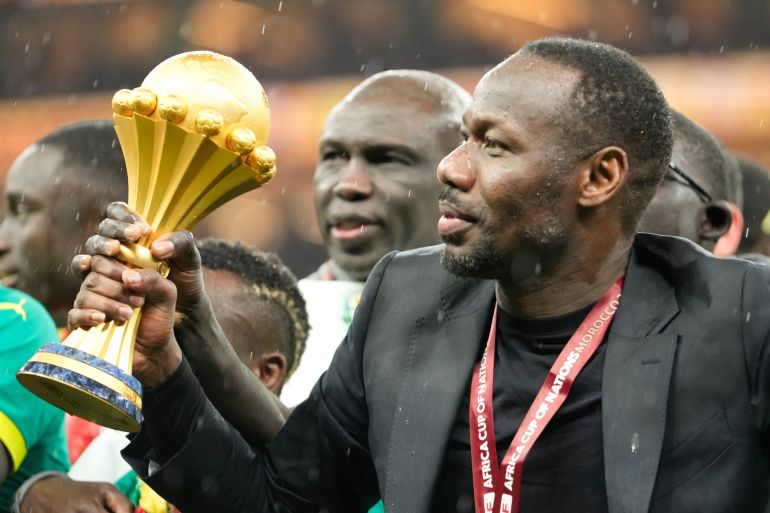
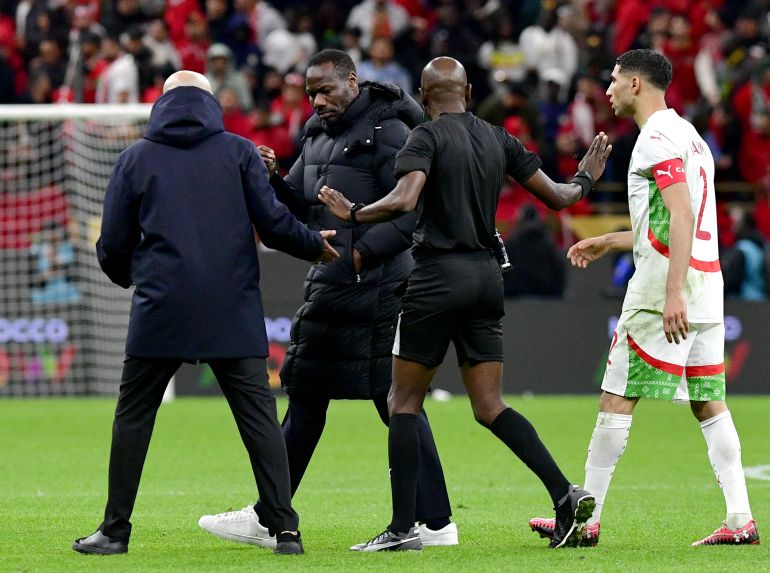
Senegal’s head coach Pape Thiaw has apologized for his actions during the 2025 Africa Cup of Nations final, after he asked his players to leave the pitch in protest of the referee’s decision to award a penalty to Morocco in stoppage time, with the score tied at 0-0.
In a message addressed to football fans, Thiaw said: “I apologize if I caused harm to anyone, but football fans understand well that passion is an integral part of this sport.”
He shared photos on his Instagram account of him leading the “Lions of Teranga” and lifting the African trophy, commenting: “For Senegal, my heart, soul, and mind are rooted in this beautiful country which has given me everything, and for which I would do the impossible.”
He added about his actions on the night of the final last Sunday: “We experienced an extraordinary tournament with fantastic organization, but it unfortunately ended in a dramatic finale. My intention was never to violate the principles of the game I love so much; I was only trying to protect my players from injustice.”
He continued: “What some may see as a breach of the rules was, in reality, merely an emotional reaction to the biased situation we faced. After consultation, we decided to complete the match and move forward to win this trophy for you.”
The coach thanked the President of Senegal, the Ministry of Sports, and the Football Federation for providing the best conditions and support for the national team. He also gave special thanks to the Senegalese fans who supported the team from the beginning of the tournament until the last moment.
He concluded his message by saying: “I would not have achieved all of this without my family: my mother who has passed away, my father, my wife, and my children who give me an additional source of motivation. Finally, I say to my men, those 28 warriors who gave their sweat, blood, and soul for their country: It is my pride to lead you. You are not just legends, but extraordinary people.”
Africa Cup of Nations
The Africa Cup of Nations (AFCON) is the premier international men’s football competition in Africa, first organized in 1957. It was founded to celebrate African football independence and unity, with its inaugural tournament featuring just three nations. Today, it is held every two years and has grown into a major global sporting event, showcasing the continent’s top talent and passion for the sport.
Senegal
Senegal is a West African nation known for its rich cultural heritage and historical significance as a center of several pre-colonial empires and a major hub in the transatlantic slave trade. Its cultural sites include the UNESCO-listed Island of Gorée, a poignant memorial to the slave trade, and the Saint-Louis historic colonial city. Today, it is celebrated for its vibrant music, art, and the influential Sufi brotherhoods that shape its society.
Morocco
Morocco is a North African country with a rich history shaped by indigenous Amazigh (Berber) cultures, Arab influence from the 7th century, and later European interactions. It is renowned for its diverse cultural sites, from the ancient Roman ruins of Volubilis to the imperial cities of Marrakech, Fez, and Meknes, which feature vibrant medinas (old towns) and historic Islamic architecture. The country’s unique identity is a blend of Arab, Amazigh, African, and European traditions.
Rabat
Rabat is the capital city of Morocco, founded in the 12th century as a military outpost by the Almohad Caliphate. Today, it is a modern political and administrative center, recognized as a UNESCO World Heritage Site for its well-preserved historic quarters, including the Hassan Tower and the Chellah necropolis, which showcase a blend of Islamic and European colonial influences.
Lions of Teranga
The “Lions of Teranga” is the affectionate nickname for the Senegal national football team, inspired by the country’s national animal (the lion) and the Wolof concept of “Teranga,” meaning hospitality. The team rose to global prominence in 2002 when it reached the FIFA World Cup quarter-finals, famously defeating defending champions France in its opening match. They are celebrated not only for their athletic achievements but also as symbols of national pride and the welcoming spirit of Senegalese culture.