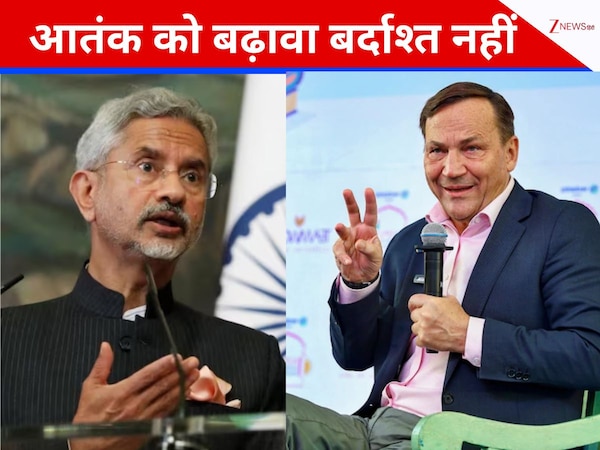
India–Poland Relations: The External Affairs Minister held bilateral talks with Poland’s Foreign Minister in Delhi on Monday. During the meeting, the two leaders discussed security, trade, and global geopolitical circumstances in detail. During this conversation, the External Affairs Minister bluntly told his Polish counterpart that we cannot tolerate any leniency towards terrorism. He stated in front of the Polish Foreign Minister that Poland, like India, should show zero tolerance against terrorism. Targeting Pakistan, he told Poland that terrorist structures active in India’s neighborhood should not be promoted in any way.
During the conversation with Poland’s Foreign Minister, he clearly expressed India’s concern regarding cross-border terrorism sponsored by Pakistan, stating that the international community needs to unite and adopt a firm stance against such terrorism. During this, he emphasized that local stability is only possible when effective and significant pressure is applied on forces supporting terrorism. It is noteworthy that recently Poland had held talks with Pakistan on the Kashmir issue. In this context, the sharp tone likely made the Polish Foreign Minister realize this point.
Polish Foreign Minister Praises India
Additionally, he also registered his objection to criticism of India’s policies regarding the Ukraine war and Russian oil imports. He said that targeting India for purchasing cheap crude oil from Russia by Western countries is wrong and unjust. He stated that India makes decisions based on its energy needs and national interests, and it is not appropriate to question this. Poland’s Foreign Minister also appreciated India’s role in global energy security, the Ukraine conflict, and the changing circumstances in the Indo-Pacific region. Both leaders agreed to further strengthen cooperation in defense, technology, and the economy.
Poland Recognizes Cross-Border Terrorism
He further stated that Poland is well acquainted with our region and also knows the long-standing problem of cross-border terrorism well. He expressed hope that Poland will also adopt a policy of zero tolerance against terrorism and will not provide any political, diplomatic, or moral assistance to terrorist structures active in India’s neighborhood. He said, ‘We are meeting at a time when the entire world is facing major turmoil. In such an atmosphere, it becomes even more essential for international communities to adopt a clear and united stance against terrorism.’ He also said that attempts to justify terrorism under any cause or context are dangerous for global security.
India
India is a vast and ancient civilization in South Asia, home to one of the world’s oldest continuous cultures, with roots in the Indus Valley Civilization dating back over 5,000 years. It is renowned for its profound spiritual traditions, diverse languages, and a rich history marked by great empires, colonial rule, and its emergence as the world’s largest democracy. Iconic cultural sites, from the Taj Mahal to countless temples and monuments, reflect its layered historical and religious heritage.
Poland
Poland is a Central European nation with a rich and complex history, marked by its establishment as a unified kingdom in 1025, a golden age in the 16th century, and a series of partitions that erased it from the map for over a century before its rebirth in 1918. Its cultural landscape is profoundly shaped by Roman Catholicism and a resilient national identity, reflected in historic sites like the medieval capital of Kraków, the Warsaw Old Town (rebuilt after WWII), and the sobering Auschwitz-Birkenau memorial. Today, it stands as a vibrant EU member state known for its medieval castles, picturesque old towns, and contributions from figures like Copernicus and Chopin.
Pakistan
Pakistan is a modern nation-state established in 1947 as a homeland for Muslims of British India, with a rich history rooted in the ancient Indus Valley Civilization. Its cultural landscape is a tapestry of diverse ethnic groups, languages, and traditions, heavily influenced by Islamic heritage as well as Persian, Central Asian, and South Asian legacies. Key historical sites include the archaeological ruins of Mohenjo-daro, Mughal-era landmarks like the Lahore Fort and Badshahi Mosque, and the mountainous Silk Road outpost of Taxila.
Kashmir
Kashmir is a region in the northern Indian subcontinent, renowned for its breathtaking mountain landscapes and often called “Paradise on Earth.” Historically, it has been a significant center of Hindu and Buddhist culture and later Islamic Sufism, while its modern history has been marked by a territorial dispute between India and Pakistan since the partition in 1947.
Ukraine
Ukraine is a large Eastern European country with a rich history dating back to the medieval Kyivan Rus’ state, considered a cradle of Slavic civilization. It has experienced centuries of foreign rule and conflict, gaining independence from the Soviet Union in 1991, and is globally recognized for its distinct cultural heritage, including Orthodox Christian traditions, Cossack history, and vibrant folk arts. Today, it is known for its resilient national identity amid ongoing struggles to defend its sovereignty.
Russia
Russia is the world’s largest country by land area, spanning Eastern Europe and Northern Asia. Its history is marked by the rise and fall of the Tsarist Empire, the 1917 Bolshevik Revolution that established the Soviet Union, and its re-emergence as the Russian Federation in 1991. Culturally, it is renowned for its vast contributions to literature, music, ballet, and architecture, with iconic sites like the Kremlin in Moscow and the Hermitage Museum in Saint Petersburg.
Indo-Pacific region
The Indo-Pacific region is a vast maritime and cultural expanse stretching from the Indian Ocean to the western and central Pacific Ocean. Historically, it has been a crossroads of ancient trade routes, cultural exchange, and colonial empires, connecting diverse civilizations from East Africa to East Asia. Today, it is a strategically vital area of global economic activity and geopolitical significance.
Delhi
Delhi is India’s capital city, with a history spanning over two millennia, serving as the seat of several empires including the Delhi Sultanate and the Mughals. It is a major cultural and political hub, renowned for its striking contrasts between ancient monuments like the Red Fort and Qutub Minar and modern government buildings. The city’s layered history is vividly reflected in its diverse neighborhoods, from the medieval lanes of Old Delhi to the planned avenues of New Delhi, established as the imperial capital by the British in 1911.