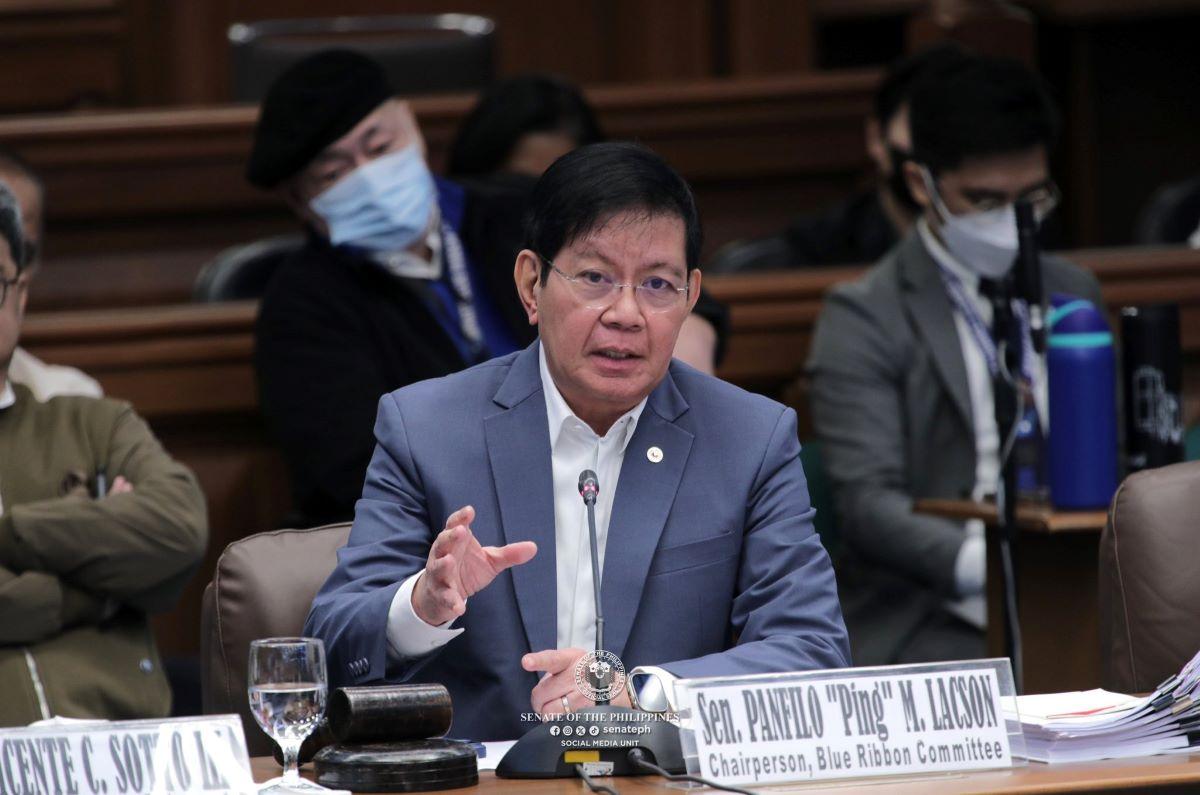
The Senate blue ribbon committee will resume its hearing on flood control projects on January 19 at 1 p.m., chairperson Senator Panfilo “Ping” Lacson said.
In an interview, Lacson said the committee will discuss the reported retraction of former Department of Public Works and Highways (DPWH) – Bulacan engineers Henry Alcantara and Brice Hernandez.
The Department of Justice (DOJ) said that Alcantara retracted his previous revelations during the Senate blue ribbon committee’s hearing last September.
“Nevertheless, we will talk about the consequences should they plan to retract or recant their affidavit submitted to the blue ribbon committee,” Lacson said.
He added that the committee will clarify with the DOJ if the former DPWH engineers submitted a counter affidavit of their testimony.
“We will inform them that if they recant, they will be held liable for perjury. For any sworn statement made under oath, penalties have been increased,” Lacson said.
Lacson earlier reported that Alcantara, Hernandez, and two other DPWH engineers have received funds from casinos in Metro Manila, Cebu, and Pampanga from 2023 to 2025 in what could be a money laundering scheme.
The Senate blue ribbon committee will also invite former Education undersecretary, former DPWH secretary Manuel Bonoan, and other resource persons who failed to show up at the previous hearings.
Lacson said a subpoena will be issued should they fail to attend again.
Should Alcantara and Hernandez recant their statements, Lacson said the case would still stand since there is other evidence pointing to those who are accountable.
“The DOJ or the Ombudsman will also consider whether there are money and paper trails that connect to their testimonies,” Lacson said.
Lacson said the committee is also planning to invite Batangas 1st District Representative Leandro Leviste with regards to the so-called “Cabral files.”
The senator added that he is set to meet with former DPWH undersecretary Maria Catalina Cabral’s lawyer next week to clarify the allocable amounts, particularly the Special Allotment Release Order (SARO) for flood control projects and other infrastructure projects issued on December 27, 2024.
In the said SARO, the P50 billion came entirely from unprogrammed appropriations.
“P30 billion of the P50 billion went to flood control projects. Many on the list are ghost projects. We want to clarify with the Department of Budget Management and the Office of the Executive Secretary how a SARO was still released from unprogrammed appropriations in late 2024 for infrastructure projects,” Lacson said.
Senate blue ribbon committee
The Senate Blue Ribbon Committee is a special investigative body within the Philippine Senate, established to probe matters of national importance involving government anomalies, corruption, and waste. It was formally created in 1992 by Senate President Neptali Gonzales to strengthen the Senate’s oversight function, though similar “blue ribbon” investigative panels have existed in various forms since the American colonial period. Its high-profile investigations into major scandals have made it a prominent and powerful institution in Philippine politics.
Department of Public Works and Highways (DPWH)
The Department of Public Works and Highways (DPWH) is the Philippines’ primary government agency responsible for the planning, design, construction, and maintenance of national infrastructure, including highways, bridges, and flood control systems. It traces its origins to the Spanish colonial-era *Dirección General de Obras Públicas* and was formally established in its current form in 1899, playing a central role in the country’s physical development and disaster resilience.
Department of Justice (DOJ)
The United States Department of Justice (DOJ) is the federal executive department responsible for enforcing federal law and administering justice, established by Congress in 1870. It is headed by the Attorney General, a position created much earlier in 1789, and oversees agencies like the FBI, DEA, and federal prisons. Its history involves enforcing civil rights laws, prosecuting federal crimes, and representing the U.S. government in legal matters.
Metro Manila
Metro Manila is the bustling capital region of the Philippines, officially established in 1975 by merging four cities and thirteen municipalities. Its history, however, stretches back centuries to the founding of Spanish Manila in 1571, which became a vital colonial port and trade hub. Today, it is the nation’s political, economic, and cultural center, marked by a dense urban landscape that contrasts historic Spanish-era landmarks with modern skyscrapers.
Cebu
Cebu is a major island province in the Philippines, historically significant as the site of the first Spanish settlement in the country. It is renowned for the Magellan’s Cross, planted by Portuguese explorer Ferdinand Magellan in 1521, which marks the introduction of Christianity to the archipelago. Today, Cebu City is a bustling metropolitan hub known for its vibrant festivals, historic Spanish-era churches, and as a gateway to the region’s beautiful beaches and diving spots.
Pampanga
Pampanga is a province in the Philippines, located in the Central Luzon region, historically known as the first Spanish province on the island of Luzon, founded in 1571. It is celebrated for its rich culinary heritage, often called the “Culinary Capital of the Philippines,” and its vibrant festivals like the Giant Lantern Festival (Ligligan Parul). The area also showcases resilient Kapampangan culture, having rebuilt and thrived after major disruptions like the 1991 eruption of Mount Pinatubo.
Batangas 1st District
The **Batangas 1st District** is a legislative district in the Philippines comprising the City of Tanauan and the municipalities of Talisay, Laurel, Agoncillo, San Nicolas, Santa Teresita, Alitagtag, Cuenca, and Mataasnakahoy. Historically, its center, Tanauan, is a significant heritage area known as the hometown of national hero Apolinario Mabini and former President José P. Laurel. The district encompasses towns around the iconic Taal Volcano, an area with a deep history shaped by volcanic activity, revolutionary figures, and the cultivation of local industries like coffee.
Department of Budget Management
The Department of Budget Management (DBM) is a key executive agency of the Philippine government, established in 1936. It is primarily responsible for formulating the national budget, managing public resources, and ensuring the efficient allocation of government funds to support national development goals and fiscal discipline.