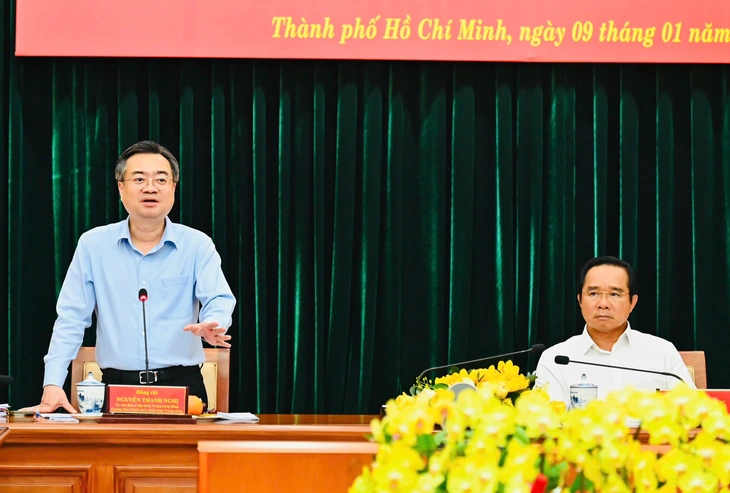
Head of the Central Policy and Strategy Commission Nguyen Thanh Nghi requested Ho Chi Minh City to proactively implement new specific mechanisms and policies for the city to create a breakthrough in the growth model based on knowledge and innovation.
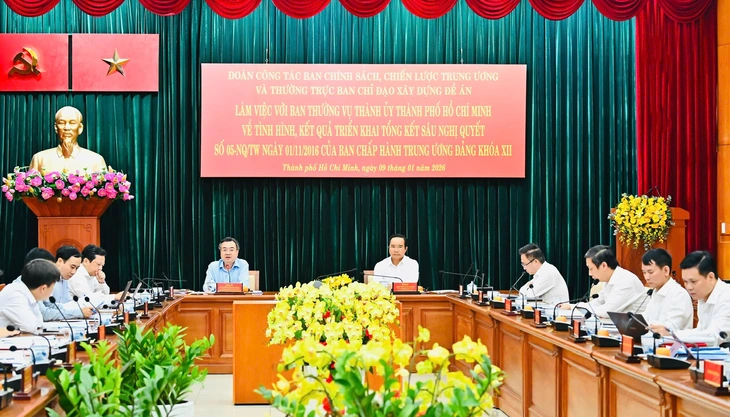
On the afternoon of January 9, the working delegation of the Central Policy and Strategy Commission and the Standing Committee of the Steering Committee for building the project on strategic solutions to promote in the new era – the era of the Vietnamese nation’s rise associated with the review of Resolution 05 of the 12th Party Central Committee had a working session with the Standing Committee of the Ho Chi Minh City Party Committee.
Ho Chi Minh City still faces challenges from competition in attracting investment
The meeting was chaired by the Head of the Central Policy and Strategy Commission and the Deputy Secretary of the City Party Committee, Chairman of the Ho Chi Minh City People’s Committee.
According to the report, after nearly 10 years of implementing Resolution No. 05, Ho Chi Minh City and localities in the region have concretized and organized the implementation, achieving many important and relatively comprehensive results.
Thereby, contributing to promoting socio-economic development, gradually renewing the growth model and improving the quality of growth of Ho Chi Minh City.
However, Ho Chi Minh City still faces many difficulties due to incomplete infrastructure; lack of high-quality human resources; environmental pollution issues remain challenging; the wealth gap is still large.
In addition, Ho Chi Minh City also faces challenges from competition in attracting investment, adapting to climate change, ensuring cybersecurity, and preserving socio-cultural identity.
In light of this situation, the city must transform its growth model, enhance competitiveness with appropriate, flexible, and effective solutions.
At the same time, it must comprehensively restructure the development space, with a new vision as an international megacity, fulfilling the pioneering, leading, and spreading development mission for the whole country.
Focus on building Ho Chi Minh City into a major service center for the whole country
Concluding the working session, the Head of the Central Policy and Strategy Commission assessed that Ho Chi Minh City’s implementation of Resolution 05 has achieved important results, thereby making a very large and important contribution to the country’s economic growth and development.
Analyzing the advantages and potential of Ho Chi Minh City, the Head of the Central Policy and Strategy Commission requested Ho Chi Minh City to focus on implementing strategic solutions and the city’s proposed projects and plans to promote double-digit economic growth in the 2026-2030 period.
Accordingly, Ho Chi Minh City continues to implement three strategic breakthroughs in policy and institutions; infrastructure development; and human resource development.
Among these, continue to focus on resolving and definitively handling long-standing difficulties and obstacles for projects, works, and land to quickly unlock resources for development.
Ho Chi Minh City implements National Assembly Resolution 260 on amending and supplementing a number of articles of Resolution No. 98 on piloting a number of specific mechanisms.
He also requested Ho Chi Minh City to proactively implement new specific mechanisms and policies for the city to create a breakthrough in the knowledge-based, innovative growth model; focus on organizing the implementation and successful development of new economic models, creating new growth momentum.
At the same time, focus on well-performing urban planning and governance, developing the city according to the Transit-Oriented Development (TOD) model; effectively promote the new development space of Ho Chi Minh City “one center, three regions, one special zone”; promote new growth drivers, develop service strengths.
In parallel, Ho Chi Minh City also accelerates the restructuring of economic sectors, focusing on building Ho Chi Minh City into a major service center for the whole country and the region with high-end, modern service industries.
The Head of the Policy and Strategy Commission also emphasized building the Ho Chi Minh City Free Trade Zone to mobilize resources, attract strategic investors, and promote the development of priority areas such as finance, trade, high-quality services, and research & development (R&D), thereby enhancing the city’s international competitiveness.
At the same time, focus on developing science – technology, innovation, and digital transformation: building large data centers meeting international standards; forming science and technology parks, research centers, and laboratories meeting