
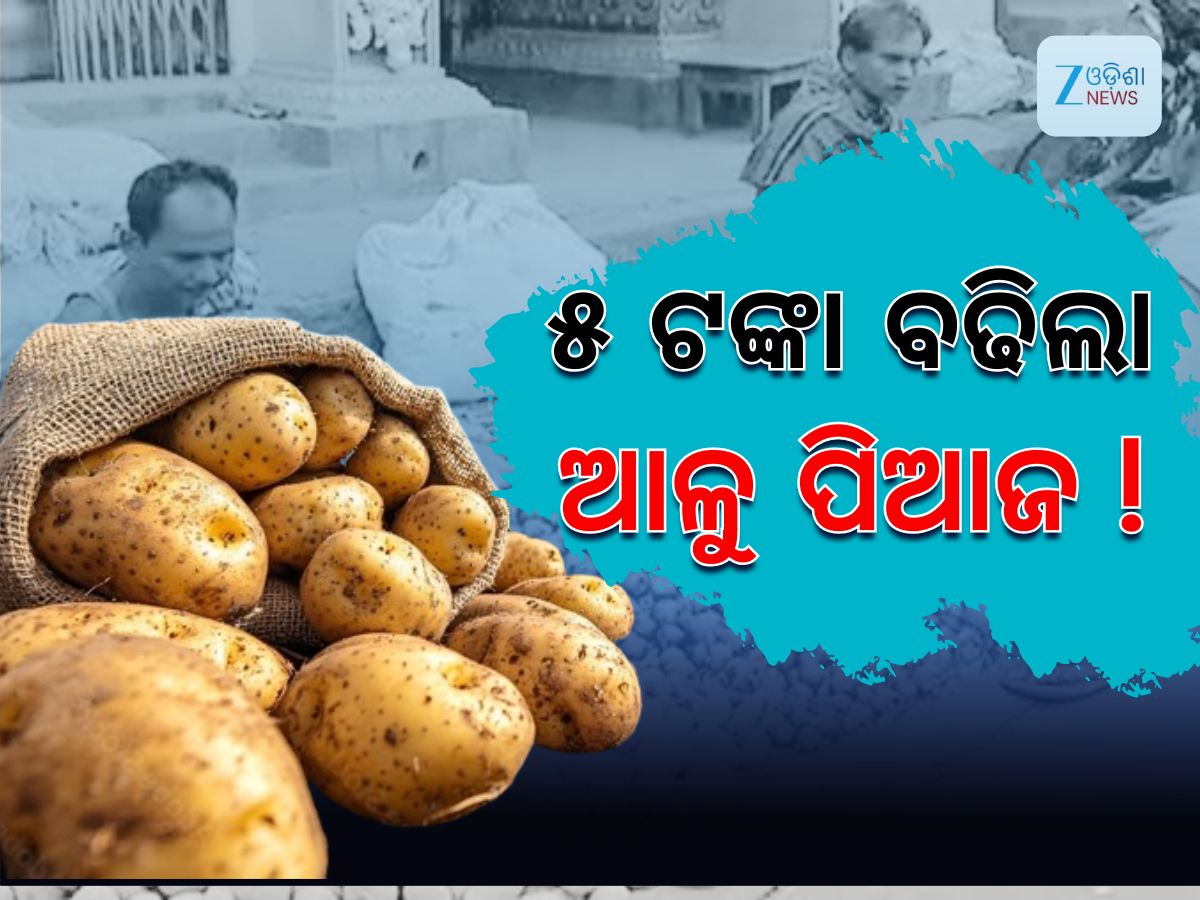
Potato Crisis: Capital faces potato shortage, no supply trucks for 2 days

Potato Crisis: Bhubaneswar: The capital is facing a potato crisis once again. A shortage has emerged as no potato-laden trucks have arrived from Kolkata since Saturday. This has caused concern for the government about how to supply potatoes to the market. On one hand, there is the threat of a cyclone, while on the other, the shortage of potatoes will burden consumers. Not only that, but on Sunday, the price of potatoes and onions increased by 5 rupees per kilogram in some places. As a result, potatoes are selling for 25 rupees and onions for 30 rupees. The fact that potatoes, which were previously available for 20 rupees, and onions for 25 rupees, have suddenly increased by 5 rupees each has surprised many. Consumers have complained about black marketing during the cyclone alert. Nevertheless, the Revenue Minister has instructed against black marketing during the cyclone. However, it remains to be seen how effective this will be.

For the past few months, potato prices in Bhubaneswar had been stable. Potatoes were selling at 20 rupees per kilogram in wholesale and retail markets. Although the prices of other vegetables increased during the month of Kartik, potato prices remained satisfactory. However, even before the cyclone’s arrival, confusion has arisen again regarding potatoes. Until now, 200 to 300 tons of potatoes were arriving daily in Bhubaneswar from Kolkata. While the daily requirement in Bhubaneswar is 250 tons, an adequate supply was reaching the market. Not only the Bhubaneswar market, but potatoes from here also go to suburban areas like Balianta, Balipatna, Chandaka, Jatni, Khordha, and Puri. However, the fact that potato trucks have not been coming from Kolkata since yesterday has increased the worries of traders and warehouse owners. If trucks do not arrive in the coming days, there is a fear that potato prices will rise further. Along with this, the supply of potatoes to suburban areas will also be disrupted.

Regarding this, a senior trader from Kuberpuri said that consumers should not worry at all. We are fully aware of the potato supply situation. We have a stock of 500 to 700 tons of potatoes that will last until next week. Therefore, he assured that there will be no potato crisis in the capital now. However, he said he has no information about any price increase.

The General Secretary of the State Traders Association said there is currently no potato crisis in Odisha. The expected quantity of potatoes is arriving. The monthly requirement is 1.2 lakh tons. The wholesale price per quintal of potatoes is between 1500 and 1600 rupees. Accordingly, potatoes are being sold at 20 rupees per kilogram. Currently, 90 percent of potatoes come from Kolkata. There will be no potato crisis during the cyclone. A letter from the Chief Secretary arrived today. It instructs traders to maintain sufficient stocks of potatoes, flattened rice, rice, and other essentials and to ensure an orderly supply. We will manage the supply accordingly.

On the other hand, the Revenue Minister has warned that strict action will be taken against black marketing during the cyclone. The minister stated that if anyone is found selling food items at inflated prices, exemplary punishment will be imposed against the concerned trader.

Bhubaneswar

Bhubaneswar is the capital city of India’s Odisha state, renowned as the “Temple City” for its cluster of hundreds of ancient Hindu temples. Its history dates back over 2,000 years, with the iconic Lingaraj Temple representing the peak of Kalinga architecture from the 11th century. While the old city preserves this ancient heritage, modern Bhubaneswar was planned and built as a new capital in the mid-20th century.

Kolkata

Kolkata, formerly known as Calcutta, is the capital of India’s West Bengal state and was the capital of British India until 1911. Founded as a trading post by the British East India Company in 1690, it grew into a major colonial port and a historic center for Indian art, literature, and nationalist thought. Today, it is a vibrant, densely populated metropolis renowned for its cultural heritage, colonial architecture, and as the home of figures like Rabindranath Tagore.

Odisha

Odisha, located on India’s eastern coast, is renowned for its ancient Hindu temples, tribal heritage, and classical Odissi dance. Historically known as Kalinga, it was the site of a pivotal war in 261 BCE that led Emperor Ashoka to embrace Buddhism, profoundly shaping the region’s spiritual landscape. Its cultural legacy is epitomized by the 13th-century Sun Temple at Konark and the Jagannath Temple in Puri.

Balianta

Balianta is a town and block in the Khordha district of Odisha, India, known for its rich cultural heritage and traditional craftsmanship, particularly in stone carving. Historically, it was part of the ancient Kalinga region and is noted for its centuries-old temple dedicated to Goddess Kali, which attracts pilgrims and is central to local festivals. The area also played a role in India’s freedom struggle, with local leaders participating in movements against colonial rule.

Balipatna

Balipatna is a village located in the Khordha district of Odisha, India, historically significant as the site of the Battle of Balipatna in 1760. In this conflict, the Maratha forces defeated the local Afghan garrison, which was a key event in the Maratha expansion into the region. Today, it is primarily known as a suburban area near the state capital of Bhubaneswar.

Chandaka

Chandaka is a wildlife sanctuary located near Bhubaneswar in Odisha, India, originally established as an elephant reserve. Historically, the area was once part of a vast forest used as a hunting ground by regional kings. Today, it is a protected habitat known for its conservation efforts for elephants, leopards, and other native species.

Jatni

Jatni is a town and municipality in the Khordha district of Odisha, India, primarily known today as a major railway junction. Historically, its significance is linked to its proximity to the ancient capital of the Kalinga empire and its role as a transit point, with archaeological finds in the area indicating settlements dating back centuries.

Khordha

Khordha is a historic town in the Indian state of Odisha, most famous as the last capital of the independent Kalinga kingdom before its fall to the British East India Company in 1804. It is also renowned for the nearby Barunei Temple, an ancient Shakti Peetha site atop the Barunei Hills, which holds significant religious importance.