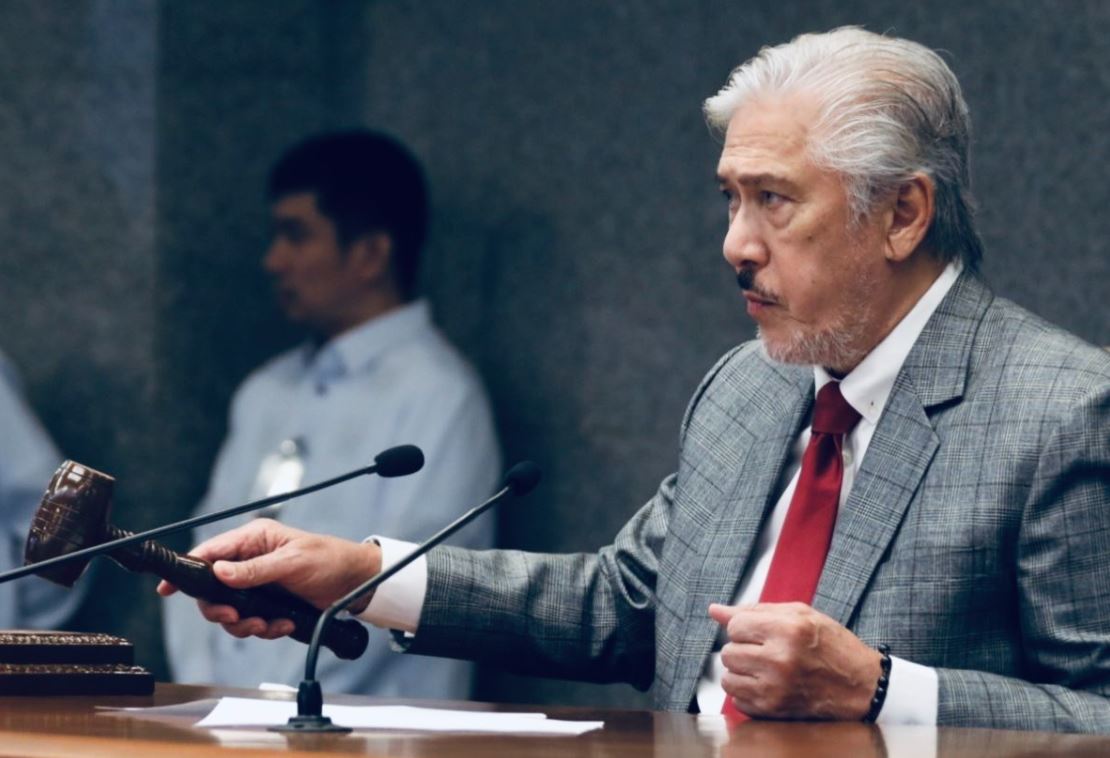
Senate President Vicente “Tito” Sotto III on Monday floated the possibility of the national government operating on a reenacted budget for the beginning of 2026.
Sotto said that if the Office of the President has already started reviewing the bicameral conference committee report, there is a possibility for President Ferdinand “Bongbong” Marcos Jr. to sign the budget bill by December 30 or 31.
“But I doubt it. Perhaps, somewhere like, sometime like, first week of January would be ideal that they have already reviewed it,” Sotto said.
Asked if there will be negative implications for such a reenacted budget, Sotto said, “There’s none. There’s no problem if the budget is reenacted for a few days or a week or so.”
The Senate on Monday amended its legislative calendar, moving the resumption of the plenary session on December 29, in time for the proposed P6.793-trillion 2026 national budget.
This came after the House of Representatives earlier in the day also approved the motion to its legislative calendar to ratify the bicameral conference committee report.
Sotto has emphasized that under his leadership, a “blind ratification” of the proposed budget will never be allowed.
“I don’t want a summary, I don’t want a blind ratification of the budget just like what happened last year. As far as I’m concerned, while I’m Senate President, I want it to be clear. What we will ratify is clearly, almost an enrolled copy or enrolled copy of the bill that will go to the President. That should be very clean and without insertion whatsoever,” he said.
The bicameral conference committee adjourned early Thursday morning, wrapping up the proposed P6.793-trillion national budget for fiscal year 2026 after four days.
Senate
The Senate is the upper chamber of the United States Congress, established by the U.S. Constitution in 1789. It was designed to provide equal representation for each state, with two senators per state, serving as a deliberative body to balance the populism of the House of Representatives. Historically, it has powers to approve treaties, confirm presidential appointments, and conduct trials of impeached officials.
Office of the President
The Office of the President is the executive branch and administrative headquarters of a nation’s government, led by the elected head of state. Its history and specific form vary by country, but it generally evolved from earlier monarchical or colonial administrations into a modern, constitutionally-defined institution. For example, in the United States, the White House serves as both the official residence and office of the president, a role established after the presidency was created by the U.S. Constitution in 1789.
House of Representatives
The House of Representatives is the lower chamber of the United States Congress, established by the Constitution in 1789. It is composed of representatives elected from congressional districts across the country, with representation based on state population, and it holds primary responsibility for initiating revenue bills and impeaching federal officials.
bicameral conference committee
A bicameral conference committee is a temporary legislative body formed when the two chambers of a legislature (like the U.S. House and Senate) pass different versions of the same bill. Its purpose is to negotiate a single, compromise version that can be sent back to both chambers for a final vote. This process is a fundamental feature of bicameral systems, designed to reconcile differences and produce legislation acceptable to both houses.