Grass and benches installed at the east entrance of Yokohama Station—social experiment “Hama Terrace” begins to create liveliness.
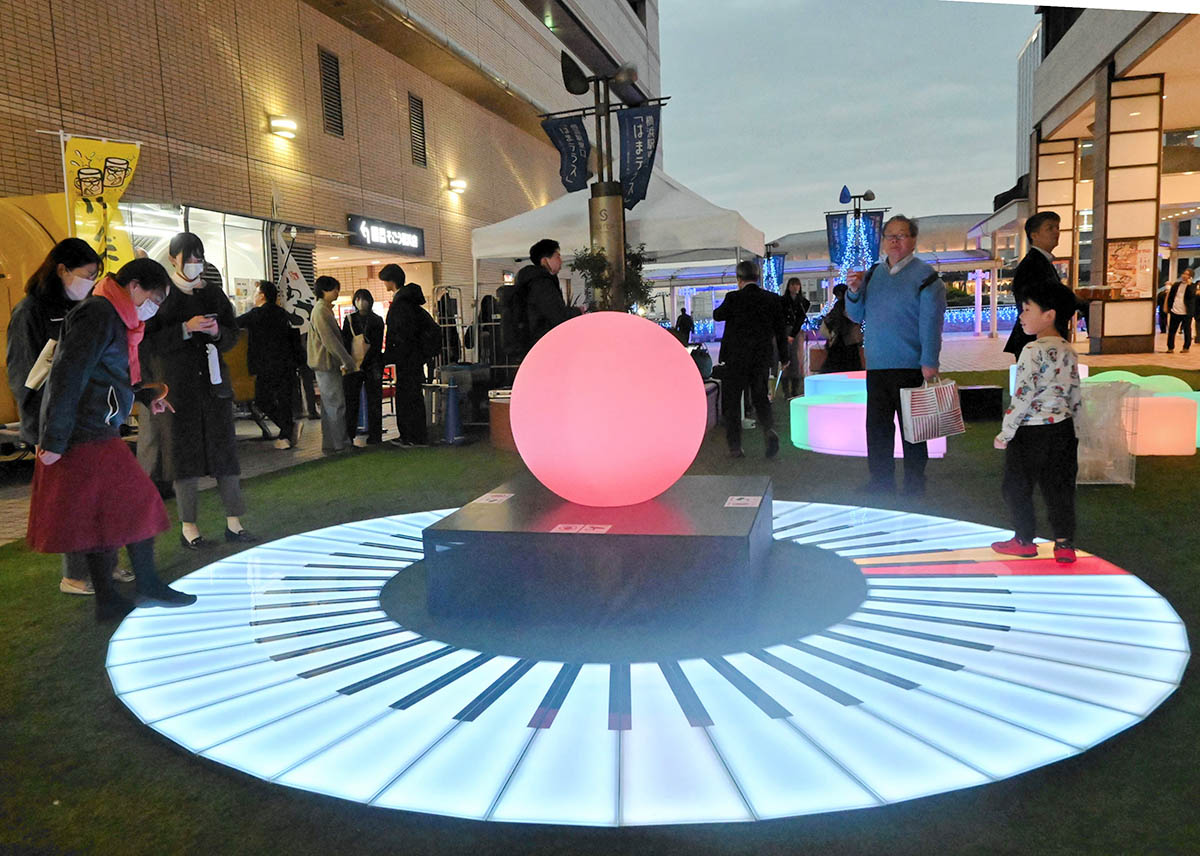
Hama Terrace decorated with light installations. Aims to create a vibrant space for relaxation in Nishi Ward, Yokohama
A social experiment to create a new relaxation space at Yokohama Station’s East Exit began at “Hama Terrace” (Nishi Ward, Yokohama), jointly managed by Yokohama New Urban Center and Yokohama Sky Building. The area features lawns and benches with nighttime light displays, aiming to create a vibrant atmosphere. The experiment will continue until February 28th of next year.
Hama Terrace decorated with light installations. Aims to create a vibrant space for relaxation in Nishi Ward, Yokohama
Hama Terrace is a pedestrian deck connecting the second floors of Yokohama New Urban Building (which houses Sogo Yokohama store) and Sky Building. The social experiment aims to attract people to this key connection point between Yokohama Station and the Minato Mirai 21 area. Daily illumination displays operate from 4:00 PM to 11:00 PM, and kitchen trailers are also available, encouraging use throughout the day and night for shopping breaks and relaxation.
The initiative aims to create more than just a temporary experiment, seeking to develop this currently vibrant area in Yokohama into a starting point for further revitalization. Future considerations will focus on developing the space as a gathering place that people can enjoy visiting.
Hama Terrace
The Hama Terrace is a historic irrigation system located in Hama, Syria, dating back to the Byzantine era or earlier. It features a series of enormous wooden water wheels, known as norias, which were used to lift water from the Orontes River to supply the city and its gardens. These iconic structures stand as a testament to ancient engineering and remain a symbol of Hama’s cultural heritage.
Yokohama Station
Yokohama Station is a major railway hub in Kanagawa Prefecture, Japan, which first opened in 1872 and was one of the country’s earliest train stations. It has since been rebuilt and expanded multiple times, evolving into one of the busiest transportation centers in the world. Today, the station and its surrounding area form a vibrant commercial and business district, reflecting Yokohama’s growth as a key international port city.
Yokohama New Urban Center
The Yokohama New Urban Center, developed in the 1980s, is a major business and cultural district in Minato Mirai 21, Yokohama. It was built on former shipyard and industrial lands as part of a large-scale urban redevelopment project to create a new city center for the 21st century. The area is famous for its iconic landmarks, including the Landmark Tower, Japan’s second-tallest building, and serves as a hub for commerce, shopping, and tourism.
Yokohama Sky Building
The Yokohama Sky Building is a 70-story skyscraper located in the Minato Mirai 21 district of Yokohama, Japan. Completed in 1993, it was the tallest building in Japan until 1993 and is a prominent symbol of the city’s modern redevelopment. The building is primarily used for offices but is famous for its 69th-floor observation deck, the Sky Garden, which offers panoramic views of Yokohama and, on clear days, Mount Fuji.
Nishi Ward
Nishi Ward is one of the seven wards of Yokohama, Japan, and serves as a major administrative and business center for the city. Historically, it was a collection of small farming and fishing villages before being largely developed through extensive land reclamation projects in the 20th century. Today, it is known for landmarks like the Yokohama Stadium and the vibrant Chinatown, which is the largest in Japan.
Yokohama New Urban Building
The Yokohama New Urban Building, commonly known as “The New Urban,” is a historic landmark built in 1929 in the Kannai district. It was Japan’s first earthquake-resistant reinforced concrete office building and became a symbol of Yokohama’s modern reconstruction following the Great Kanto Earthquake of 1923. Today, it is preserved as a cultural property and houses shops and restaurants while retaining its original Taisho-era architectural charm.
Sogo Yokohama store
The Sogo Yokohama store is a major department store located in the Minato Mirai 21 district, which opened in 1985. It was a key commercial anchor in the redevelopment of Yokohama’s former shipyard area into a modern business and cultural center. The store is known for its extensive product selection and its iconic clock tower, which has become a popular local landmark.
Minato Mirai 21
Minato Mirai 21 is a large urban development in Yokohama, Japan, whose name translates to “Harbor of the Future 21.” Built on former shipyard and industrial land, its development began in the 1980s with the goal of creating a futuristic business and cultural district for the 21st century. Today, it is a major tourist destination known for its iconic skyline, which includes landmarks like the Landmark Tower and Cosmo Clock 21 Ferris wheel.