On the afternoon of November 26th
A five-alarm fire broke out at Hong Fu Yuan in Tai Po, Hong Kong
Causing significant casualties
What are the characteristics of high-rise building fires?
How should you escape if you encounter one?
These essential facts are important to know
High-rise fires are difficult to fight, have multiple hazards, slow evacuation, and spread quickly
Difficult to fight: Considering factors like access for aerial equipment, operational space, and weather conditions, if indoor firefighting systems fail, fighting the fire from outside becomes extremely challenging.
Multiple hazards: High-rise buildings contain various types of spaces and complex layouts, which can delay the best timing for alerting authorities and rescue operations.
Slow evacuation: High-rise buildings have many floors and occupants, long vertical distances, making evacuation time-consuming and difficult.
Rapid spread: High-rise buildings have significant fire loads and numerous vertical shafts. Based on actual fire investigations, smoke can fill an entire space in as little as three minutes.

△ Flammable and combustible external insulation materials
How to escape from a high-rise fire?
During evacuation, cover your nose and mouth with a wet towel to avoid inhaling smoke, and wrap your body with a wet quilt. If smoke is already spreading, stay low and move quickly.
Assess the danger based on your location
Fire on a floor above you: This situation is the least dangerous. The fire is above, you are below, and the fire and smoke are blocked by the floor slab. Simply use the stairs to go down; do not take the elevator.
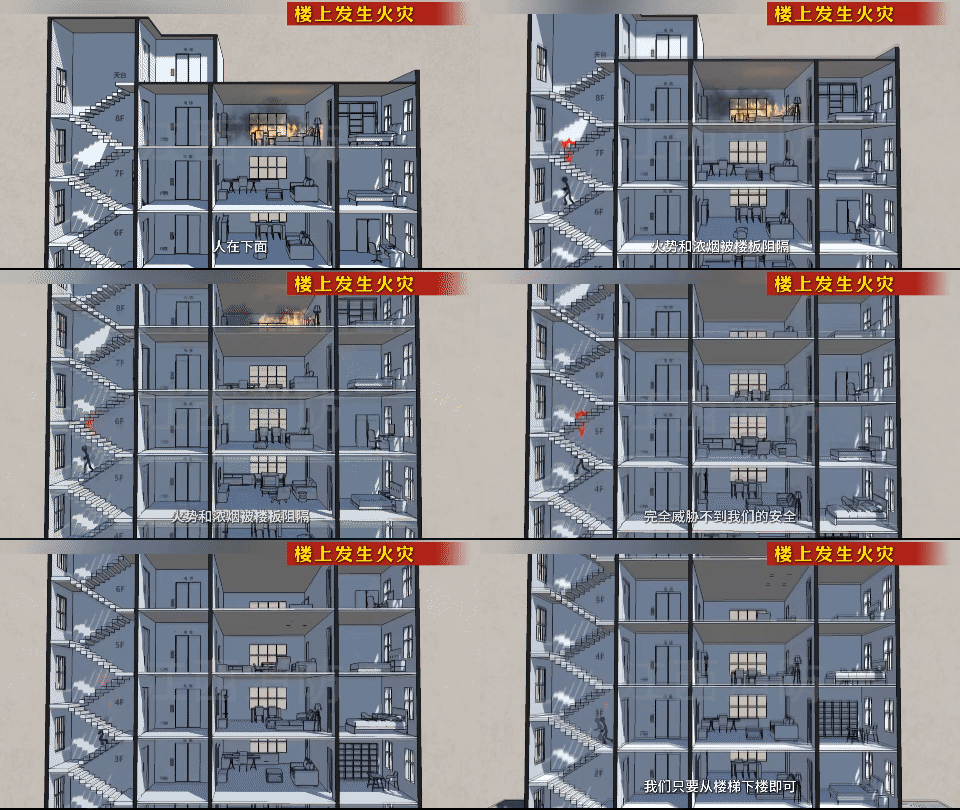
Fire on the same floor: This situation is relatively dangerous. Whether to escape or not depends mainly on the smoke conditions.
You can open the door a crack:
If there is no thick smoke outside, evacuate downstairs immediately;
If there is smoke, return inside, close the main door securely, seal the gaps to prevent smoke entry, and wait for rescue.
Fire in your immediate vicinity:
If a fire starts inside your unit and you cannot control it, evacuate immediately;
If the fire blocks the path to the main door, find a bathroom or room with an external window, close the door, seal the gaps to prevent smoke, and wait for rescue.
Fire on a floor below you: This situation is extremely dangerous. Many people perish in such scenarios due to attempting to escape blindly.
In this case, whether to escape or not is determined by checking the smoke when opening the door:
If opening the door a crack reveals heavy smoke pouring in, it means the corridor and stairwell are filled with smoke. You should retreat inside, close the door to keep smoke out, and wait for rescue;
If you open the door and the corridor has no smoke, but the stairwell is smoky, still retreat inside, close the door, and wait for rescue;
If you open the door and there is no smoke in the corridor or the stairwell, you can evacuate quickly.
Remember the eight-character principle
“Escape small fires quickly, seal yourself in from large fires”
When should you “escape small fires quickly”?
If a fire starts in your own home and you cannot extinguish it yourself, and if the fire hasn’t blocked your escape route, you should run. The situation will become more dangerous if you wait.
If a fire starts in a neighbor’s home and could potentially spread to yours, and there