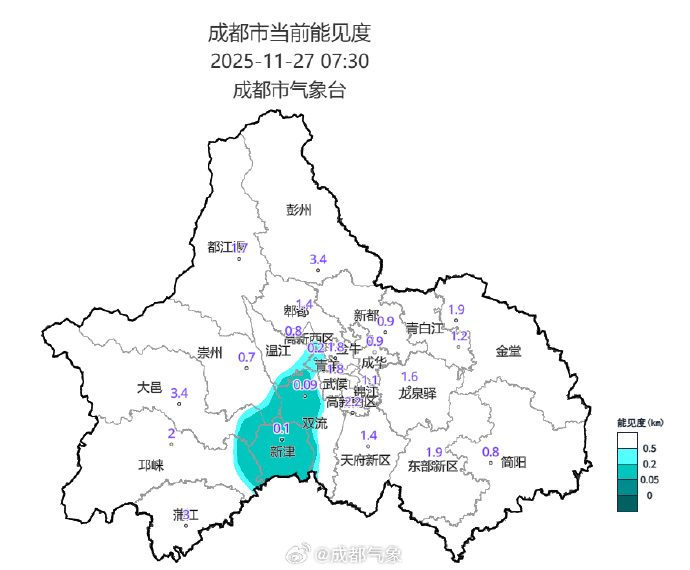
At 07:40 on November 27, the Chengdu Meteorological Observatory issued a short-term fog forecast: Currently, parts of Xinjin, Shuangliu, Tianfu New Area, Xindu, Pujiang, and Jianyang have already experienced fog with visibility less than 500 meters, and in some areas visibility is less than 200 meters. It is expected that in the next 3 hours, visibility in the aforementioned districts, cities, counties, and surrounding areas will be below 500 meters, and below 200 meters in some places. Please take precautions against the adverse effects of foggy weather.
After entering autumn and winter, surface radiation cooling becomes significant, nighttime temperatures drop rapidly, and moisture in the air easily reaches saturation and condenses to form radiation fog. This radiation fog is the main type of fog in autumn and winter, especially likely to form on clear, breezy nights or early mornings. Additionally, temperature inversion layers are more common in autumn and winter, with stable atmospheric conditions near the ground that prevent moisture from dissipating easily. This stable atmospheric environment favors the persistence of fog.
Traveling in foggy conditions with low visibility and slippery road surfaces significantly increases safety risks. Here is a practical fog travel safety guide for your reference.
Key Safety Points for Driving
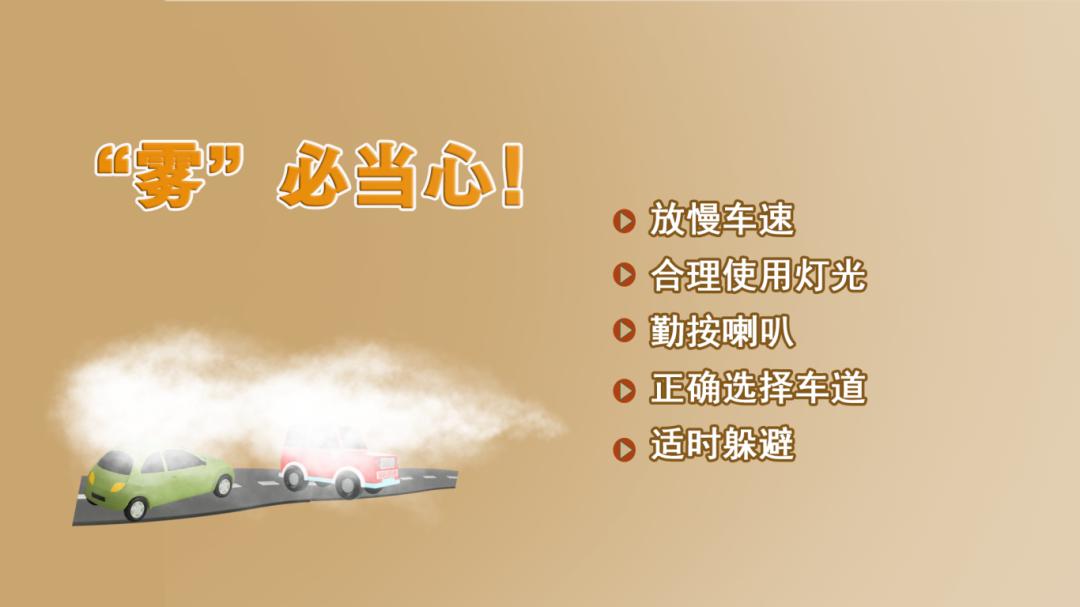
Turn on Fog Lights
Be sure to turn on both front and rear fog lights (not hazard lights or high beams). Fog lights have strong penetration and can improve vehicle visibility.
Do not use high beams, as they can create a “light curtain effect” in fog, actually reducing visibility.
Maintain Safe Following Distance
Braking distance increases in foggy conditions. Maintain at least 1-2 times the normal following distance to avoid sudden braking and rear-end collisions.
Drive Slowly and Steadily
Strictly control your speed, avoiding sudden acceleration, braking, and sharp turns. When visibility drops below 50 meters, exit the highway at the nearest opportunity or pull over and wait.
Use Horn Cautiously
When visibility is extremely poor, use your horn appropriately to signal and alert other vehicles.
Avoid Sudden Lane Changes and Overtaking
It’s difficult to judge the position of vehicles to the side and rear in fog. Try to maintain a constant speed in your lane.
Precautions for Cycling/Electric Scooter Travel
Wear reflective or bright-colored clothing to increase your visibility.
Slow down, avoid sudden braking, and be mindful of slippery road surfaces.
Try to travel during daylight hours when visibility is better, avoiding early morning or nighttime periods with heavy fog.
Safety Recommendations for Walking
Walk on sidewalks, staying away from vehicle lanes.
When crossing the street, always ensure it is safe. You can wave appropriately to make yourself more noticeable to drivers.
Avoid staying for long periods in areas where fog tends to be thicker, such as under bridges or in tunnels.
First Heavy Pollution Weather Warning This Winter! Effective at 00:00 on the 28th
Based on a joint air quality consultation by provincial ecological environment and meteorological departments, it is forecast that starting November 28, meteorological conditions in most of the basin will deteriorate, with a risk of light to moderate particulate matter pollution in some cities in the Chengdu Plain, southern Sichuan, and northeastern Sichuan.
In accordance with the requirements of the Provincial Ecological Environment Protection and Inspection Work Leading Group Office for initiating heavy pollution weather warnings and joint prevention and control, and the relevant regulations of the “Chengdu Heavy Pollution Weather Emergency Plan (2024 Revision),” Chengdu has decided to initiate a Yellow Alert for heavy pollution weather effective at 00:00 on November 28.
During this warning period, the Sichuan Basin is at risk of being affected by the transport of dust masses originating from southwestern Mongolia. Cities in northeastern Sichuan and the northern part of the Chengdu Plain may experience light to